

Troyes: timber frames, stained glass and an Aube base
Troyes’s old centre has the outline known locally as the Bouchon de Champagne. Its named walking sights include Saint-Jean-au-Marché, ruelle des Chats, Sainte-Madeleine, Saint-Urbain and the cathedral of Saint-Pierre-et-Saint-Paul. The tourist office’s walking route links these town sights; cellar estates in the Côte des Bar lie outside the city.
The Paris–Troyes TER route is advertised from 1 hour 29 minutes by TER Grand Est. Troyes’s official access information names the A26 from Calais and Reims and the A5 from Paris, Langres and Dijon. A train to Reims is not a direct arrival at Troyes: use Troyes as the station in SNCF Connect.
Saint-Jean-au-Marché and ruelle des Chats
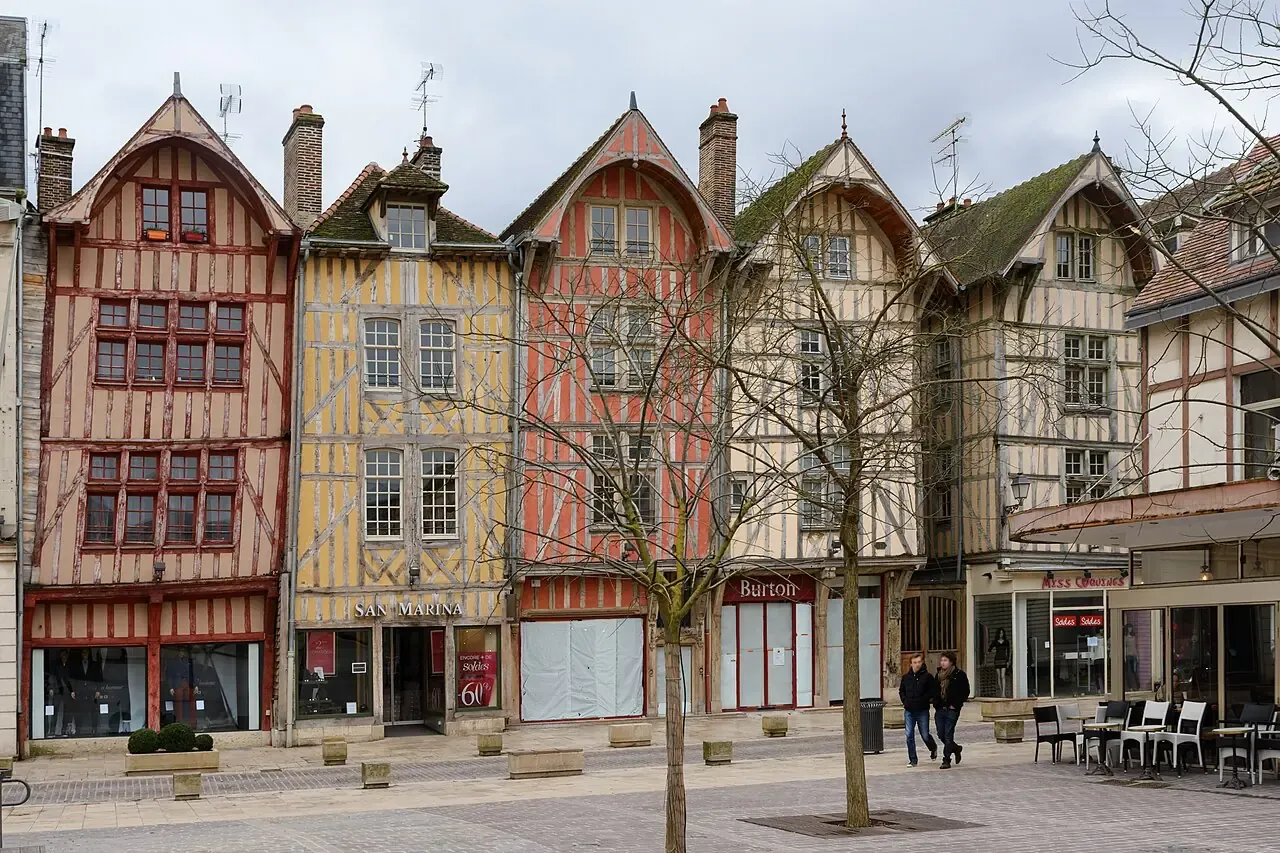
The Saint-Jean-au-Marché quarter contains 16th-century timber-framed houses and medieval street alignments. Place du Marché au Pain and the neighbouring streets reflect the trade around the Champagne fairs. Ruelle des Chats leads towards cour du Mortier d’Or and Jardin Juvénal des Ursins.
Ruelle des Chats was called rue Maillard in the 15th century. The tourist office explains the later name through houses whose rooflines nearly meet, enabling cats to cross between attics. Its central drainage channel and stone bouteroues are visible street details: the latter protected buildings from passing carts.

Sainte-Madeleine and the cathedral
Sainte-Madeleine is known for its stone rood screen and stained glass. The screen stands between nave and choir and is one of the unusual survivals in a French church. The official tourism listing identifies it as the church’s defining feature; a church visit does not require a Champagne-house booking.
The cathedral of Saint-Pierre-et-Saint-Paul has a flamboyant west façade and an unfinished Saint-Paul tower. Saint-Urbain belongs to the Gothic rayonnant tradition. Saint-Pantaléon, on rue Vauluisant, houses sculpture associated with the Troyes school; the official town route links it with Hôtel de Vauluisant.
The tourist office describes the churches through different specialities: Sainte-Madeleine’s screen, Saint-Nizier’s glazed roof, Saint-Rémy’s twisted tower, Saint-Pantaléon’s sculpture and Saint-Urbain’s architecture. The separate buildings should not be collapsed into one unnamed cathedral stop.
Museum choices around the centre
Maison de l’Outil et de la Pensée Ouvrière occupies Hôtel de Mauroy. Hôtel de Vauluisant combines collections of Champagne art and hosiery history. Maison Rachi interprets the medieval Jewish scholar and the city’s Jewish heritage. These are named alternatives to a second church visit; use the operator’s current ticket page for the chosen museum.
Rachi’s dates are 1040–1105, and the tourist office records his foundation of a Talmudic school in Troyes in 1070. The Maison Rachi visitor route includes restored courtyards, prayer and study spaces and interpretation of his work. Its visit conditions are separate from an ordinary stroll through the old centre.

Andouillette de Troyes and Chaource
Andouillette de Troyes is a pork-tripe speciality. The tourist office describes the modern local version as entirely pork and publishes recipes including andouillette gratinée au Chaource. The 5A distinction refers to the Association Amicale des Amateurs d’Andouillette Authentique; it is not a restaurant star rating.
Chaource is the region’s named cheese pairing, and the tourism office also identifies Mussy and Champ-sur-Barse among local cheeses. Rosé des Riceys is a still rosé wine from Les Riceys, not sparkling rosé Champagne. A menu offering andouillette with Chaource therefore combines two distinct local products.
The tourist-office food pages give Maison Thierry of Sainte-Savine as the contributor of the andouillette-and-Chaource recipe. Restaurant menus change; a recipe attribution establishes a producer name, not today’s fixed-price lunch or a guaranteed dish in every Troyes restaurant.
Côte des Bar producers from a Troyes base
Drappier’s visitor reception is on rue des Vignes in Urville, with cellar visits and tastings reserved directly. Devaux receives visitors at the Manoir in hameau de Villeneuve, Bar-sur-Seine. Chassenay d’Arce is at 11 rue du Pressoir, Ville-sur-Arce; Gremillet is at Envers de Valeine, Balnot-sur-Laignes.
The Côte des Bar guide separates Bar-sur-Seine, Bar-sur-Aube, Les Riceys and Essoyes. No single regional driving duration is given: the estate address determines the journey.

Drappier
Rue des Vignes, Urville. by reservation.
Devaux’s visitor estate is the Manoir on the Seine at Bar-sur-Seine. Reserve either the cellar experience or the separate tasting through its own visitor page.
Devaux
Hameau de Villeneuve, Bar-sur-Seine. public shop; appointment workshops.
Tasting workshops at the Manoir: Appointment workshops in a manor beside the Seine. Boutique: Public shop and tasting reception.
Official tourist office says house created in1846 by Jules and Auguste Devaux. Grounds include a historic dovecote.
Chassenay d’Arce
11 rue du Pressoir, Ville-sur-Arce. public booking.
At Ville-sur-Arce, Chassenay d’Arce offers its cooperative cellar route with three wines; the separate local-specialities format pairs Caractères cuvées with regional food.
Gremillet
Envers de Valeine, Balnot-sur-Laignes. public booking.
Gremillet’s visitor site at Balnot-sur-Laignes combines Clos Rocher with an arboretum, museum and production route. Its direct calendar also lists a showroom tasting without the full estate circuit.
Current shop sells visit-and-tasting pass with minimum eight participants; tasting-only minimum two.
Essoyes: Du Côté des Renoir
The Centre culturel Renoir is at 9 place de la Mairie, Essoyes; the family house and studio are on rue de l’Extra. The full Parcours Renoir ticket includes the centre, house and studio: €12 adult admission, checked October 2026. The operator recommends around two hours for the two-site visit.
The operator lists annual closures in January and December. In November outside the Toussaint holidays, the French guided departures are at 10:30 and 14:30 on Wednesday, Friday, Saturday, Sunday and public holidays, by reservation; non-French speakers have an audioguide option. The dates and reception windows appear on the official visit page.

Les Riceys and the cadoles
Les Riceys’s cadoles are dry-stone vineyard shelters. The Champagne World Heritage mission publishes three walking options: 7 km/2 hours, 14.5 km/4 hours and 23 km/7 hours. The contact is the Côte des Bar tourist office at 14 place des Héros de la Résistance, Les Riceys.
Les Riceys combines Champagne, Coteaux Champenois and Rosé des Riceys appellations. The Côte des Bar tourist route links wine villages between Bar-sur-Seine and Bar-sur-Aube; its published 220 km circuit is the length of that touring route, not the distance from Troyes to a producer.
Troyes stays and UK arrival
Search Find stays in Troyes,%20France ↗">Troyes accommodation for the old-town sights or compare Find stays in Les%20Riceys,%20France ↗">Les Riceys stays for the southern vineyards. Booking.com links use CJ affiliate tracking and we may earn commission from eligible reservations. The accommodation guide names individual properties.
From Britain, Eurostar arrives at Paris Gare du Nord; Troyes trains use Paris Gare de l’Est. The alternative road route uses LeShuttle and the A26. The official rail planner carries the last train for the chosen date; no assumed late-evening return is published here.

Cité du Vitrail: €7 adult admission in 2026
The Cité du Vitrail occupies Hôtel-Dieu-le-Comte at 31 quai des Comtes-de-Champagne. Its 2026 tariff PDF sets adult admission at €7, including the Cité du Vitrail, apothecary collection and temporary exhibition. Admission up to age 26 is free with proof of age. These figures are checked October 2026; the operator’s tariff document is the booking authority.
The tourist-office calendar gives Tuesday–Sunday opening, 10:00–18:00 through 31 October 2026 and 10:00–17:00 from 1 November 2026 through 14 March 2027. It lists exceptional closures including 1 and 11 November and 25 December 2026. Guided visits cost €3 in addition to admission, and entry is free for everyone on the first Sunday of the month.
The 2026 programme describes around sixty original stained-glass panels and new displays including Le Péché originel from the church at Mussy-sur-Seine and a forest design by Jacques Grüber from around 1905, lent by the Musée de l’École de Nancy. These close-view panels complement the in-situ glass at Sainte-Madeleine and the cathedral.
The 1874 Halles and Aux Crieurs de Vin
Troyes’s Halles were completed and inaugurated in 1874, designed by municipal architect Edmond Bailly with inspiration from Victor Baltard’s Paris markets. The tourist-office route places them by place Saint-Rémy. Their metal structure belongs to the city’s 19th-century food-market story, distinct from the older timber-framed streets around Saint-Jean-au-Marché.
Aux Crieurs de Vin is at 4–6 place Jean-Jaurès, listed by Troyes Champagne Tourisme as a restaurant originating in a wine merchant’s business. Its direct telephone is +33 3 25 40 01 01. The tourist-office listing links its restaurant booking and wine-merchant details.
Sainte-Madeleine: a stone screen and Renaissance glass
Sainte-Madeleine is at 5 rue de la Madeleine. The tourist office records a mention in 1157, a rebuilding around 1200, and alterations to the apse and choir around 1500. Its square Renaissance tower dates to about 1525. The former cemetery beside the entrance is now the Jardin des Innocents.
The surviving stone rood screen separates nave and choir. Jean Gailde designed and carved it after the clergy sought a replacement for the wooden screen around 1503; he is buried beneath his work. Originally coloured, the screen was whitened in the 18th century along with the church walls. In the choir, look for the early-16th-century Tree of Jesse and Nicolas Cordonnier’s 1506 window showing a goldsmith’s workshop.
Admission is free. The optional €2 audio guide has thirteen recorded commentaries, four language choices and a twenty-minute running time (checked October 2026). Obtain it at the church entrance. From 1 November 2026 to 31 March 2027, the tourist office lists Monday–Saturday opening at 09:30–12:30 and 14:00–17:00, and Sunday afternoon at 14:00–17:00.
Reading the unfinished cathedral
The present cathedral began in 1198 under Bishop Garnier de Trainel, with work starting at the apse chapels. The transept followed in 1260 and the first nave bays from 1310. Martin Chambiges’s west façade was finished in 1554; the Saint-Pierre tower was completed in 1634. The second, Saint-Paul tower was never built.
The cathedral measures 114 metres in length and 28.5 metres in height. Its approximately 1,500 square metres of stained glass include 13th-century choir windows and Linard Gonthier’s Mystic Wine Press of 1625. The 18th-century choir stalls and large organ came from Clairvaux Abbey, linking the Troyes building with the monastic landscape east of the Côte des Bar.
The cathedral treasury includes a Byzantine ivory box from the 11th century and Bishop Hervée’s chalice, crosier and ring. Its redesigned display opened in 2014 after two years of work. The tourist office records 160 objects displayed from a collection of 260. The treasury occupies a low-vaulted room to the right of the choir; it is a distinct collection within the cathedral.
Why so many old-town houses are Renaissance
The Grand Feu began late on 24 May 1524 in an apothecary’s house at the corner of today’s rue Émile Zola and rue Général Saussier. Troyes Tourisme estimates 1,500–1,600 houses destroyed and 3,000 people displaced. Saint-Pantaléon and Saint-Nicolas were destroyed, while Saint-Jean-au-Marché was partly ravaged.
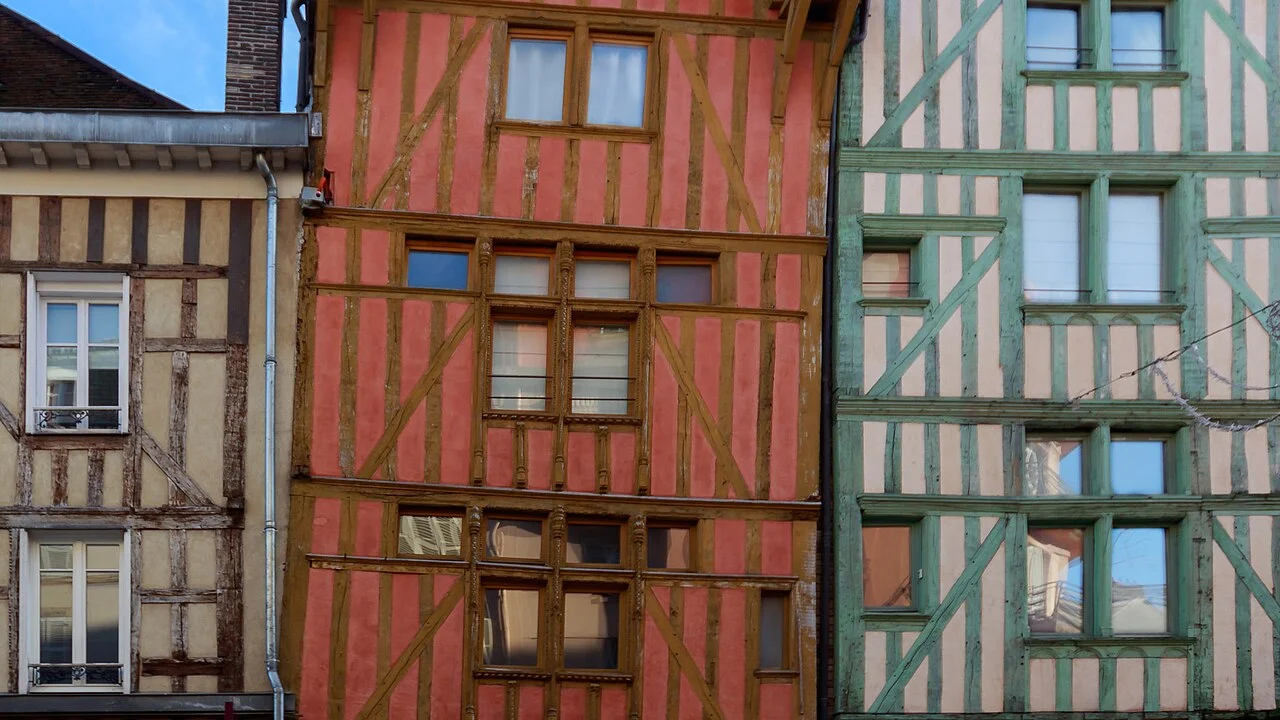
Rebuilding brought Renaissance ornament to oak-and-daub houses: decorated beam ends, corner posts and consoles. A royal edict in 1667 led to timber façades being covered with lime plaster as a fire precaution. Late-20th-century restoration removed grey render from many houses and recovered the coloured timberwork visible in the streets today. The official account states that the fire’s cause remains unknown.
Le Champ des Oiseaux on rue Linard Gonthier played a documented part in that modern restoration. In 1995 its timber frame was repainted after traces of pigment were found beneath render. The neighbouring Maison de Rhodes underwent a similar restoration. The tourist office identifies these hotel buildings as early examples of the return of colour to the old town.
MOPO: 12,000 tools in Hôtel Mauroy
The Maison de l’Outil et de la Pensée Ouvrière, at 7 rue de la Trinité, displays 12,000 hand tools from the 17th, 18th and 19th centuries in 65 cases. Its four families are wood, iron, animal and mineral trades. One display holds 330 trowels. The museum also has a specialist library and bookshop.
Jean Mauroy rebuilt the house in 1556 after the 1524 fire. He established an orphanage and school to teach trades, explaining the rue de la Trinité name. The Hôtel Mauroy was listed as a historic monument in 1862. Troyes bought it in 1966 and made it available to the Compagnons du Devoir, who restored the interior for Paul Feller’s collection.
The tourist office lists a ninety-minute guided visit for individual visitors on the first Sunday of each month at 14:30, with or without reservation (checked October 2026). Free activity booklets serve ages 8–12 and 12–16. Contact the museum on +33 3 25 73 28 26 for the guided session; its own website is mopo3.com.
Named hotels in the cathedral and Saint-Jean districts
La Maison de Rhodes is at 18 rue Linard Gonthier, beside the cathedral district. The tourist office lists eleven rooms, a garden, paved courtyard, restaurant and heated outdoor pool. A private two-hour wellness session, sauna and massage are booked separately. Its direct contact is +33 3 25 43 11 11; the tourist-office listing links to its reservation system.
Le Champ des Oiseaux is the neighbouring address at 20 rue Linard Gonthier. The tourist office lists twelve classified rooms, including one identified for visitors with reduced mobility. Its direct contact is +33 3 25 80 58 50. The two properties share the same historic street but have separate names and reservation contacts.
Hôtel Relais Saint-Jean is at 51 rue Paillot de Montabert, telephone +33 3 25 73 89 90. Its tourist-office listing links to both the hotel’s direct reservation system and Booking.com and identifies parking and baby equipment. La Licorne Hôtel & Spa is at 20 bis quai Dampierre, telephone +33 3 51 59 95 55, by the old town’s canal side.
Maison Rachi: booking and access
Maison Rachi is at 5 rue Brunneval. Its official individual French-language visit costs €24 per adult, with advance reservation required (checked October 2026). The site asks visitors to arrive fifteen minutes early carrying identification. For an English-language visit, email administration@rachi-troyes.com; group requests go through the group form or +33 3 25 73 53 01.
The building has many stairs, but Maison Rachi states that wheelchair users can reach the upper floors by lift. Its site says visits are not adapted for children under six. The downloadable outdoor route, Sur les Pas de Rachi, is a separate self-guided walk of approximately ninety minutes: it passes rue de la Synagogue, the Cour du Mortier d’Or, rue Saint-Frobert and Raymond Moretti’s Rachi memorial outside the Théâtre de Champagne.
Saint-Urbain and the cobbler’s son
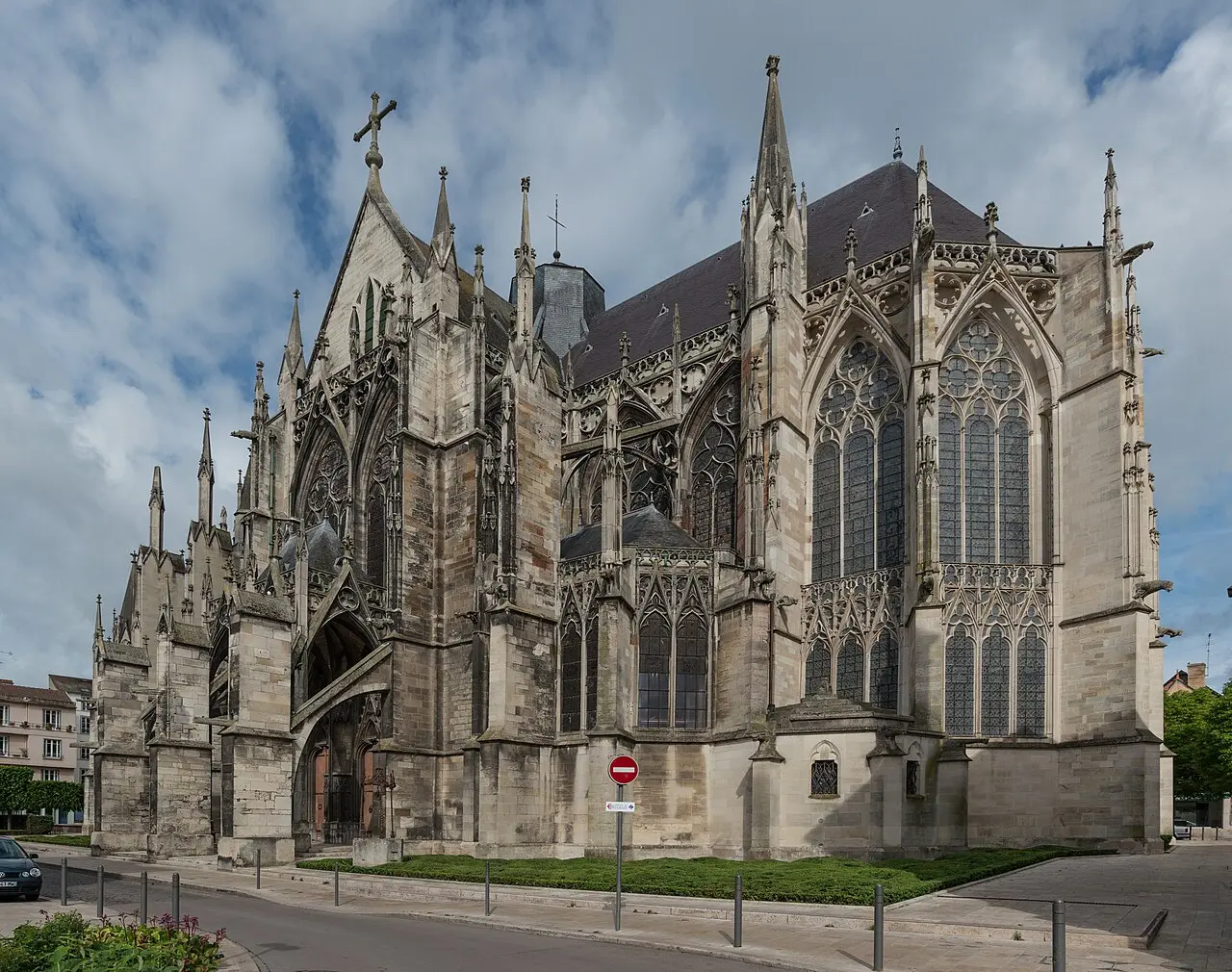
Pope Urban IV, born Jacques Pantaléon in Troyes, commissioned Saint-Urbain on the site of his father’s cobbler’s workshop. The church was erected between 1262 and 1286, with completion of the nave vault and western porch taking another six centuries. It became a basilica in 1964. Inside, the south chapel contains the 16th-century Vierge au Raisin; the chevet retains 13th-century glass.
Urban IV’s relics were returned from Perugia and placed in the choir in 1935. Outside, the main portal’s 13th-century tympanum depicts the Last Judgement. These works provide three identifiable stops at the basilica: the west portal, the south chapel’s sculpture and the stained glass at the eastern end.
Plan your trip to Troyes
Get there
Book a tour
Select the departure point and date on the booking page. Check the meeting point, language and inclusions before paying.
Compare tours ↗We may earn a commission if you book through these links, at no extra cost to you.