
Porte de Mars and the city before Champagne
Porte de Mars, on place de la République, is the most conspicuous Roman starting point for a history walk. The official city route gives the surviving arch a length of 32.4 metres. Its location beside the Hautes Promenades places ancient stonework on the same approach as the modern station and Boulingrin market quarter, well away from the cathedral’s main façade.
Roman Reims was Durocortorum. Archaeological work published by the Ministry of Culture and INRAP traces changing construction in one outlying district: timber-framed structures in the first century, a larger building on chalk foundations in the second, and later installations including hypocaust heating. The sequence reveals a working provincial city with workshops and stores, extending the story beyond a single ceremonial arch.
The same excavated district was abandoned towards the end of the third century, followed by material recovery and burials in the fourth. It then became cultivated land, with redevelopment beginning in the second half of the nineteenth century. Those archaeological layers give a long perspective on Reims: the city visitors see has repeatedly expanded over, reused and replaced earlier streets and buildings.
A coronation city, with three connected monuments
The royal story is spread across Notre-Dame, the Palais du Tau and the former Abbey of Saint-Remi. UNESCO inscribed that group in 1991 under criteria (i), (ii) and (vi), recognising architectural and sculptural achievement, influence and association with the French monarchy. The protected property covers 4.16 hectares, much smaller than the vineyard-and-cellar landscape recognised in 2015.
Reims Tourisme counts 33 royal coronations in the city; Marne tourism places the sequence between Louis the Pious in 816 and Charles X in 1825. The association with Joan of Arc centres on Charles VII’s coronation. These ceremonies gave the cathedral a national role that outlasted the medieval kingdom and explains the continued prominence of royal figures on its façade.
The ceremonies also linked buildings that now serve different purposes. The king lodged in the Palais du Tau, prayed in its Palatine Chapel and attended the banquet after the cathedral service. Saint-Remi held the Holy Ampulla used in the anointing ritual. The palace’s thirteenth-century chapel and fifteenth-century banquet hall preserve parts of that ceremonial geography beside the cathedral.
Saint-Remi’s history should be read at its own site, south of the centre. The basilica and the former abbey are distinct buildings; the Musée Saint-Remi occupies the abbey at 53 rue Simon. Together they extend Reims’s religious history beyond Notre-Dame, while the distance between the monuments shows how a coronation involved several places within the city.

The Gothic façade and its changing meaning
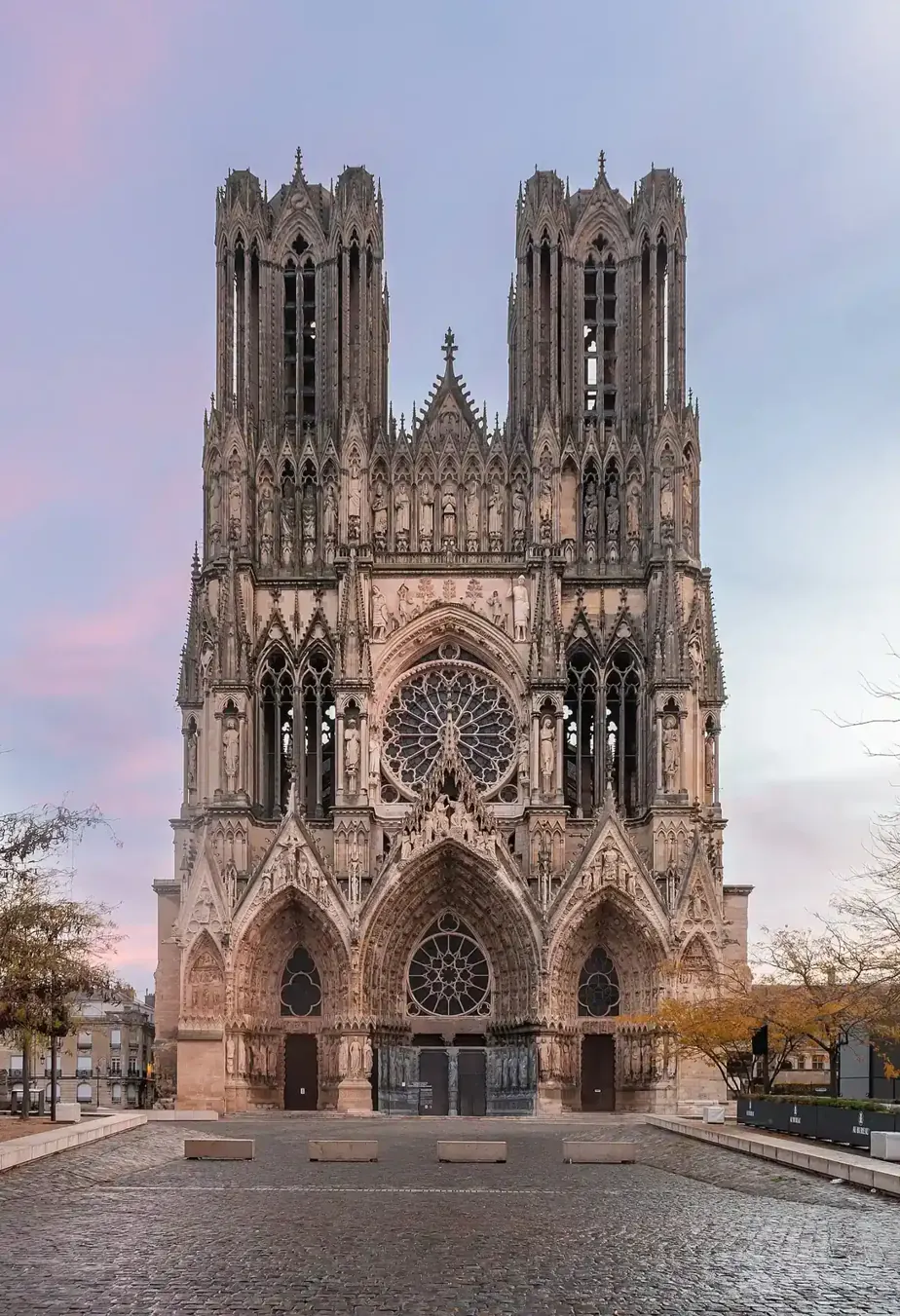
Notre-Dame’s west front has three projecting portals beneath its upper galleries and towers. The Centre des monuments nationaux identifies the left portal with the Passion, the right with the Apocalypse and Last Judgement, and the central portal with the Virgin Mary. The openwork tympana and sculpture make the façade a narrative surface, intended to be read as well as admired.
The cathedral’s sculptural programme contains 2,302 statues, with 58 royal figures on the façade. High above the portals, the mid-fourteenth-century kings’ gallery stages the baptism of Clovis: the king stands in the font beside Bishop Remi and Clotilde, while a dove carries the Holy Ampulla. That sculptural account incorporates legend into the building’s presentation of sacred monarchy.
The proportions become clearer on the high-level route: the kings’ gallery is about 40 metres above ground, with statues roughly 4.6 metres tall and close to eight tonnes. The paired towers reach 83 metres and have no spires. Their unfinished-looking silhouette is therefore part of the cathedral’s familiar historic appearance, distinct from the taller spired churches found elsewhere in France.
The Smiling Angel stands at the north portal of the west façade. Dating from the thirteenth century, the figure became a symbol of Reims through its wartime damage and restoration. Its head was lost during the cathedral fire of 19 September 1914. Seeing the restored sculpture in place connects the medieval carving with a much later story of destruction and recovery.
1914, reconstruction and twentieth-century art
The fire of 19 September 1914 destroyed the cathedral’s oak roof structure and lead covering. The roof above the vaults today is a twentieth-century reconstruction in reinforced concrete. Architect Henri Deneux assembled it between 1924 and 1926, adapting a system of small interlocking elements associated with the Renaissance architect Philibert Delorme.
John D. Rockefeller Jr began making restoration donations in 1924. The monument operator calculates that his support covered 37 per cent of the overall project. Deneux’s concrete structure has a stated volume of 2,000 cubic metres and weighs 1,600 tonnes. Those figures belong to Reims’s reconstruction history, just as firmly as the surviving stone kings belong to its Gothic history.
Marc Chagall’s three blue windows were installed in the axial chapel in 1974. They add another dated artistic layer to a cathedral already transformed by repair and replacement. The stained glass, reconstructed roof and restored Smiling Angel make Notre-Dame a record of work across centuries, with modern contributions visible inside an overwhelmingly medieval architectural setting.
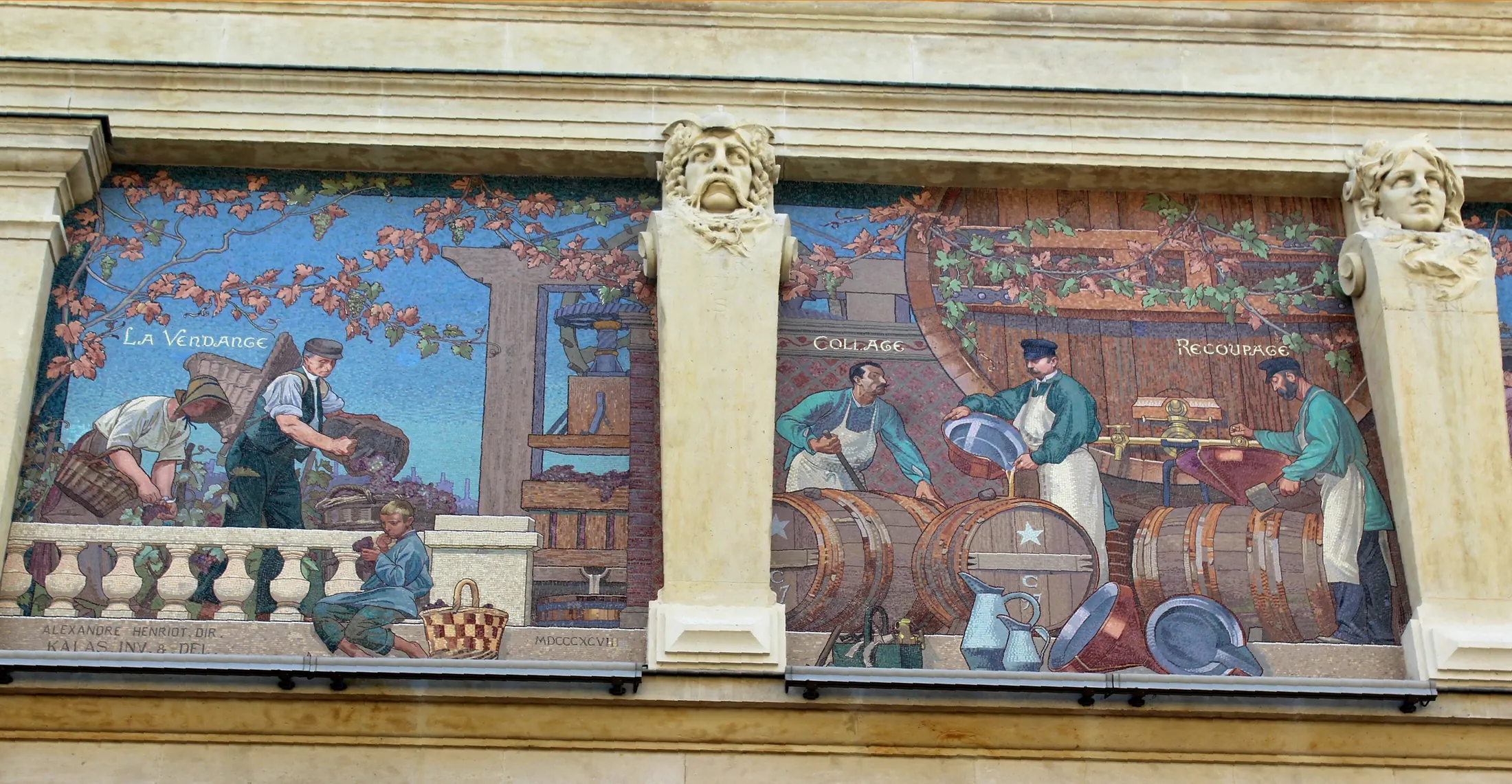
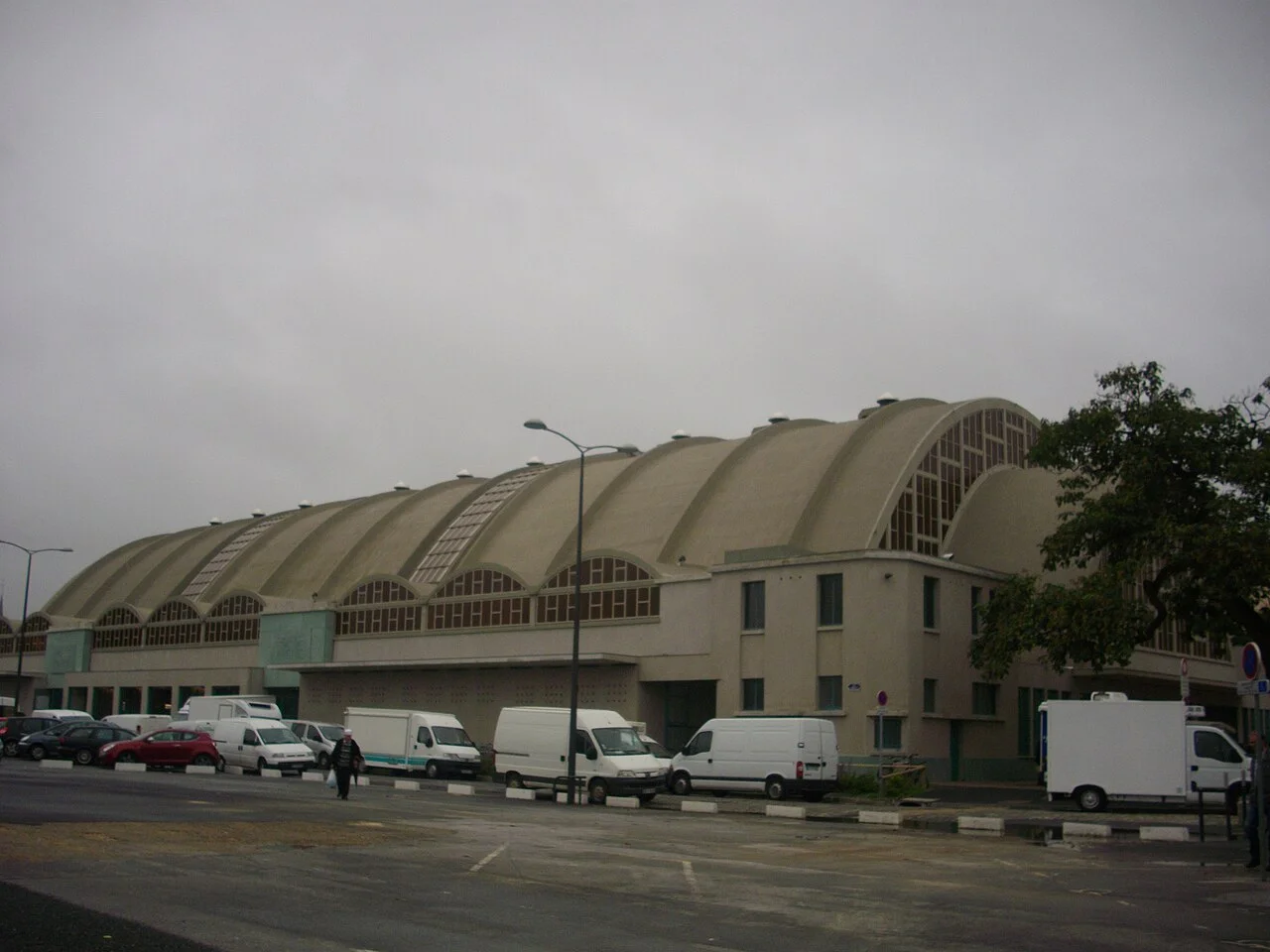
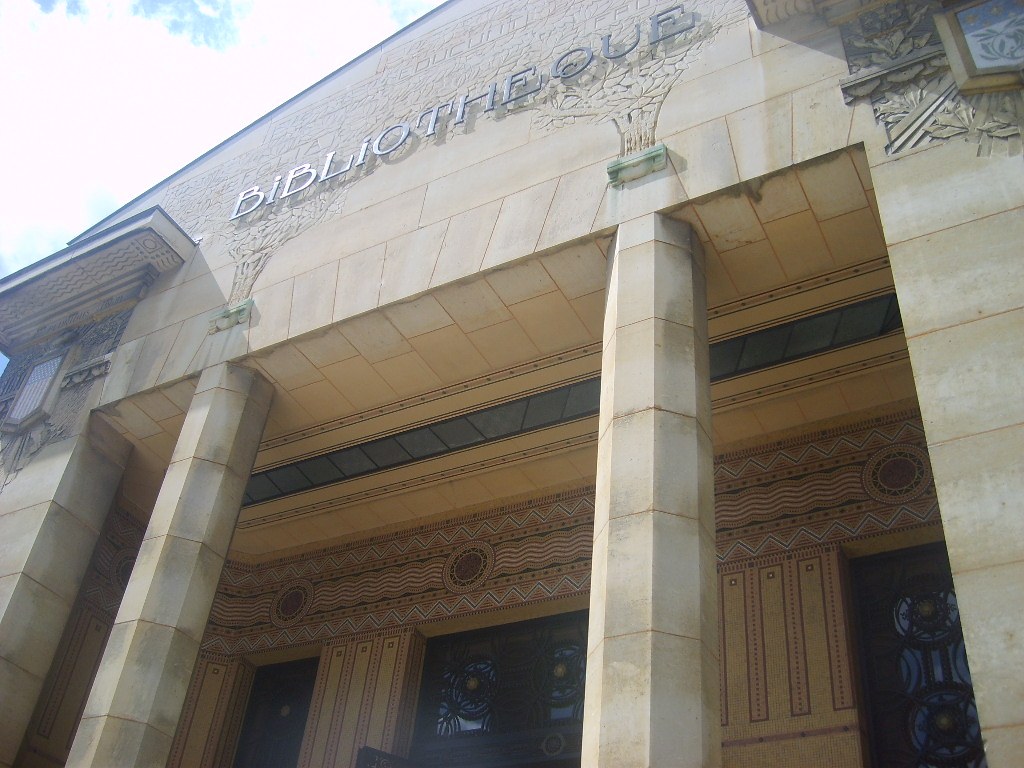
The surrounding city also expresses the rebuilding period. Bibliothèque Carnegie, at 2 place Carnegie, was funded through Andrew Carnegie’s donation and inaugurated by President Gaston Doumergue in 1928. The Art Deco library provides a named counterpart to the cathedral’s reconstruction. Halles du Boulingrin, dating from 1929, places another interwar landmark in the market quarter near Porte de Mars.

Chalk extraction becomes a Champagne landscape
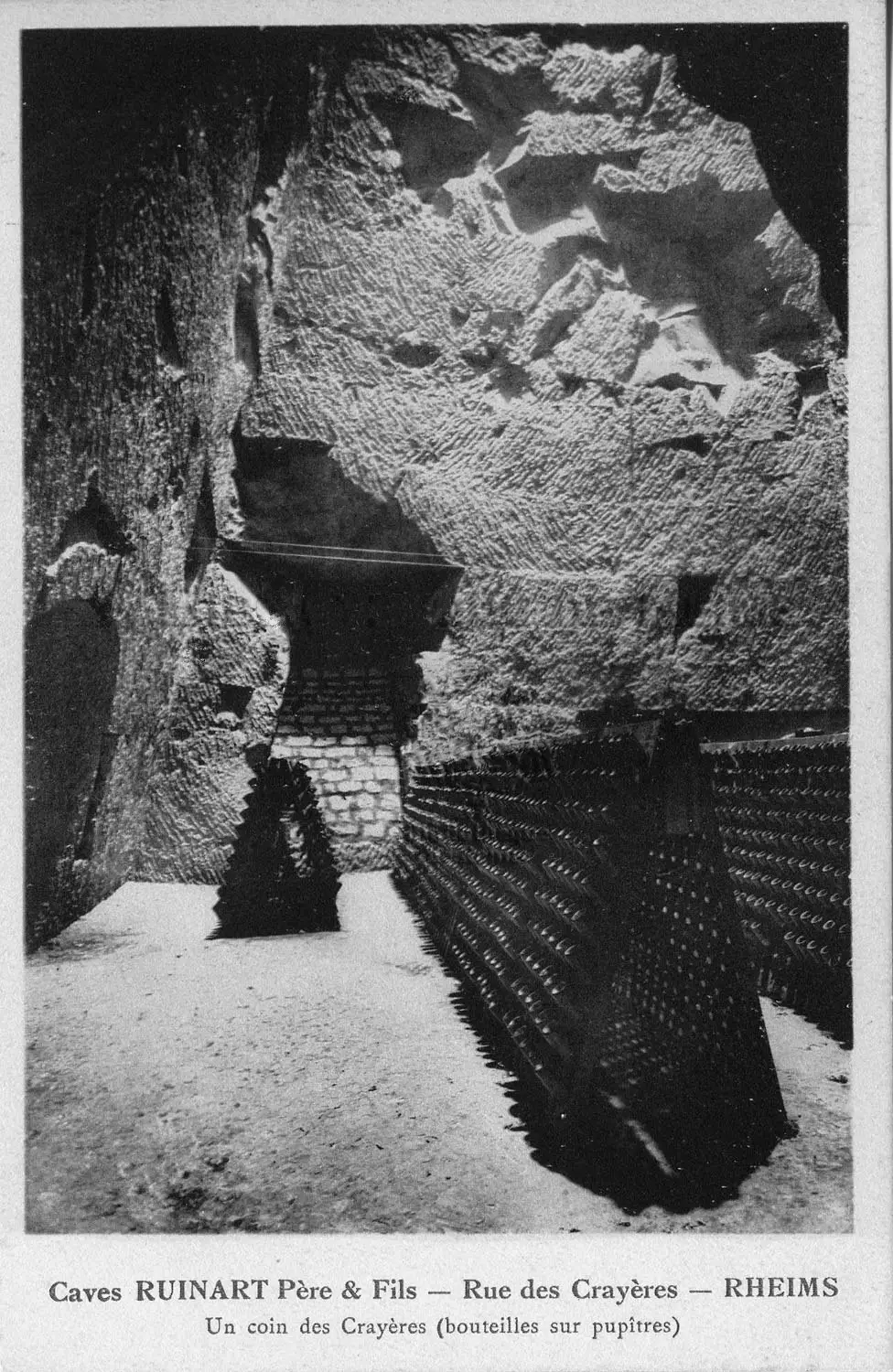
Saint-Nicaise Hill preserves a different kind of history below the south-eastern neighbourhoods. Former chalk quarries became spaces for maturing Champagne; the 2015 UNESCO inscription recognises the connection between vineyard production, manufacture, storage and trade. Ruinart, Taittinger, Pommery and Veuve Clicquot occupy separate estates on the hill, with their own underground histories and surviving surface buildings.
At Taittinger, 9 place Saint-Nicaise, the visitor site combines remains of the former Saint-Nicaise Abbey with Gallo-Roman chalk quarries. Pommery’s estate at 5 place du Général Gouraud adds Elizabethan-style industrial architecture above its chalk pits. Ruinart’s 4 rue des Crayères address links a house founded in 1729 with quarry spaces adapted for the wine trade.
Other producers demonstrate that Reims’s Champagne geography extends beyond Saint-Nicaise. G.H. Mumm, founded in 1827, is at 34 rue du Champ de Mars, north of the centre. Lanson occupies 66 rue de Courlancy to the south-west. Their separate addresses preserve a dispersed industrial city, not one continuous cellar estate or a single avenue of houses.
The surrender room and the historic city today
A final major date is preserved at 12 rue Franklin Roosevelt. The Musée de la Reddition occupies part of the former collège moderne, now Lycée Roosevelt, around the War Room where the German surrender to Allied forces was signed at dawn on 7 May 1945. The preserved map room anchors a globally significant moment in a specific Reims building.
Musée-Hôtel Le Vergeur–Maison Hugues Krafft, at 36 place du Forum, offers a different domestic and collecting history within the old centre. With Porte de Mars, Carnegie and the surrender room, it widens the historical route beyond the coronation monuments. Reims’s surviving landmarks represent Roman government, royal religion, Champagne enterprise, interwar rebuilding and the end of the European war.
The distinction between the two World Heritage dates remains useful when exploring: 1991 belongs to Notre-Dame, Saint-Remi and the Palais du Tau; 2015 belongs to Champagne’s hillsides, houses and cellars. Each inscription explains a different network of places. Together they show why a Reims history visit extends from the cathedral square to Saint-Nicaise Hill and the railway-side surrender room.


Plan your trip to Reims
Get there
Book a tour
Select the departure point and date on the booking page. Check the meeting point, language and inclusions before paying.
Compare toursWe may earn a commission if you book through these links, at no extra cost to you.