
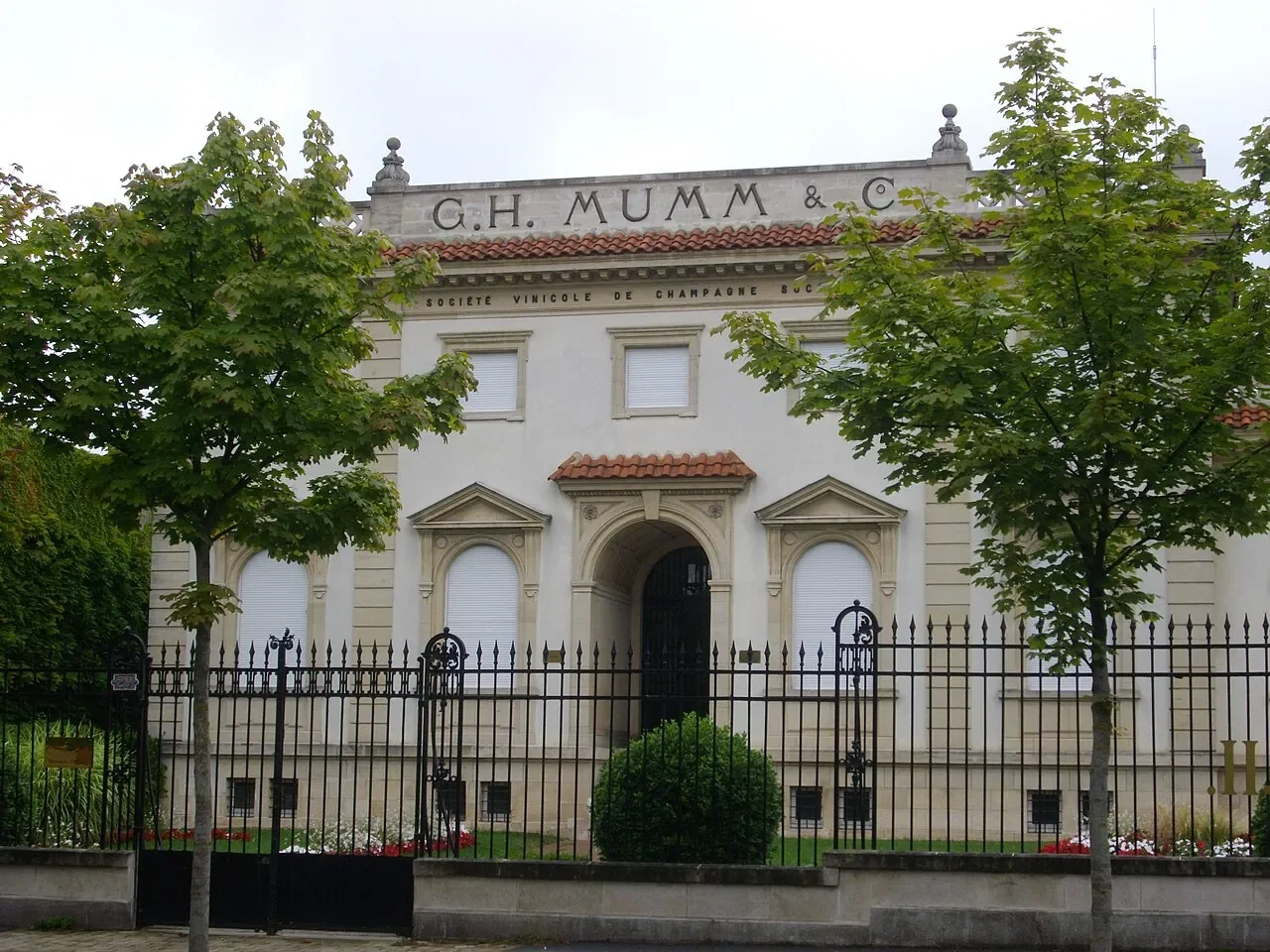

History
Gottlieb, Jacobus and Philipp Mumm founded the Reims wine business in 1827. Their father Peter Arnold Mumm had traded wine in Cologne, giving the Champagne company a family background across the French–German border.
Georges Hermann Mumm took charge in 1852; his initials remain in G.H. Mumm. Before that change, the house had purchased its first vineyard plots in Verzenay in 1840. Pinot Noir from this Montagne de Reims village remains the origin of RSRV Blanc de Noirs.
Mumm’s first recorded vintage bottling dates to 1842. Its early origins included Aÿ, Verzenay, Bouzy and Sillery. During the nineteenth century, the company also developed presses close to the vineyards, limiting the journey between picking and pressing. Seven traditional Coquard presses remain beside its vineyard holdings.
The dedicated house accounts date Cordon Rouge’s silk ribbon to 1876. Its reference is French honours, particularly the Légion d’Honneur. In 1881 the ribbon became part of the paper label. The current history uses 1876 for the anniversary, although an older passage mentions 1875.
A 2025 bottle redesign preceded the cuvée’s 150th anniversary in 2026. Cordon Rouge’s modern composition draws on a much wider palette of Champagne origins than the original Verzenay holdings, while Pinot Noir remains central to the house identity.
Léonard Tsuguharu Foujita designed a rose for Mumm in 1957 through his relationship with René Lalou. The separate Foujita Chapel in Reims, completed in 1966, extends that artistic connection beyond the bottle label. Rosé Foujita is a named wine in the RSRV range.
Mumm’s vineyard estate received High Environmental Value and Sustainable Viticulture in Champagne certification in 2016. A zero-herbicide policy followed at the start of 2020. Mechanical weeding on selected parcels uses Bakus, a robot developed by Reims-based Vitibot, adding a local engineering chapter to the vineyard’s history.
G.H. Mumm: the place and its story
Mumm’s first vineyard acquisition was at Verzenay in 1840, accompanied by a press installed near the vines. Its holdings include Aÿ, Bouzy, Ambonnay, Verzy, Verzenay, Mailly, Avize and Cramant. Pinot Noir represents 78% in the house’s vineyard account, explaining the emphasis of its Pinot Noir Celebration experience.
The Cordon Rouge ribbon refers to French honours, particularly the Légion d’Honneur. The house dates the silk ribbon to 1876 and its integration into the paper label to 1881. A redesign in 2025 led into the cuvée’s 150th anniversary in 2026. Some older history copy gives 1875 in passing; the dedicated anniversary and ribbon pages consistently use 1876.
RSRV Blanc de Blancs is Chardonnay from Cramant, where Mumm acquired historic plots in 1882. Its product page specifies a minimum of three years of cellar ageing. RSRV Blanc de Noirs is Pinot Noir from Verzenay, the village linked to Mumm’s 1840 acquisition; the separate house account gives that wine at least six years in the cellars.
RSRV Cuvée 4.5 combines five Grand Crus: Pinot Noir from Verzenay, Aÿ and Bouzy with Chardonnay from Cramant and Avize. The technical record lists 60% Pinot Noir, 40% Chardonnay, 20–30% reserve wines, at least four years of ageing and dosage of 6g/L. The name therefore refers to four years and five crus.
RSRV Lalou 2008 is an equal blend of Pinot Noir from the Montagne de Reims and Chardonnay from the Côte des Blancs. The plots are pressed and vinified separately, then blended with a 6g/L dosage. The house specifies more than ten years of ageing. Cuvée Lalou is a different prestige bottle from the two RSRV wines listed on the Vintage Grand Cru Experience.
Foujita’s rose design entered the Mumm story in 1957, commissioned by René Lalou. The painter later designed and decorated the neo-Romanesque Notre-Dame-de-la-Paix chapel in 1966 near the house. Reims tourism lists it as Chapelle Foujita. The chapel is a separate visitor attraction; its admission is not included in the three regular Mumm products listed on the current international booking page.
The official Mumm calendar reduces winter visits to Thursday–Saturday from 15 January to 28 February. It lists Thursday–Monday in March–April and 1 November–21 December, and daily visits May–October. The calendar headings do not attach a year to every range; a dated booking is the source for an individual departure.
Mumm’s pedestrian icon gives twenty minutes from Reims station, with a separate ten-minute car icon. The visit itself is on foot. Minors must remain with an adult legal representative; animals are not admitted to the cellars. Private arrangements and German or Portuguese language enquiries use guides@mumm.com.
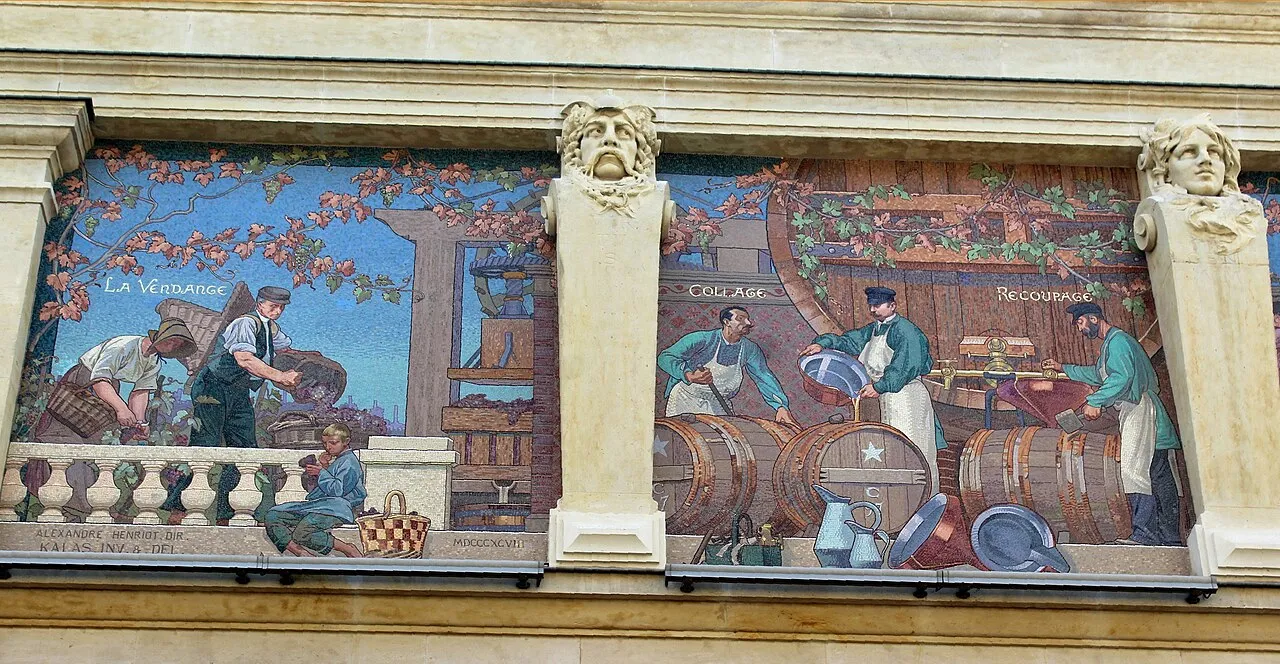

Visits and tastings
| Experience | Duration | Adult price from | Tasting | Languages | Booking |
|---|---|---|---|---|---|
| Vintage Grand Cru Experience | 90 minutes | €60 (checked October 2026) | RSRV Blanc de Blancs and RSRV Blanc de Noirs | English, French, Italian, Spanish | Official booking |
| Pinot Noir Celebration Experience | 90 minutes | €42 (checked October 2026) | Mumm Cordon Rouge and Mumm Rosé | English, French, Italian, Spanish | Official booking |
| Cordon Rouge Experience | 90 minutes | €30 (checked October 2026) | Mumm Cordon Rouge | English, French, Italian, Spanish | Official booking |
From the vineyards to the bottles in Reims
Mumm’s estate supplies about twenty-five per cent of its production needs; independent growers supply the remaining seventy-five per cent. Its own vineyards include Aÿ, Bouzy, Ambonnay, Verzy, Verzenay, Avize, Cramant and Mailly-Champagne. The house employs approximately one thousand pickers for roughly three weeks at harvest. It retains seven traditional Coquard presses close to its vineyard holdings, continuing the network of vineyard press houses developed from the 1840s to about 1910.
Mumm’s production account describes juice settling for sixteen to eighteen hours at 10–15°C, followed by alcoholic fermentation for about two weeks at 18–20°C. Crus and grape varieties remain separate before blending. The wines undergo malolactic fermentation. Its winemaking team tastes around two thousand samples annually. Bottle fermentation takes approximately one month at about 11°C, developing pressure of up to six bar. These are the house’s stated production stages, distinct from the ninety-minute visitor route through part of the cellar network.
Mumm adopted a zero-herbicide policy across its vineyards at the beginning of 2020. Its estate received Sustainable Viticulture in Champagne and High Environmental Value certifications in 2016. A mechanical-weeding robot called Bakus, developed by Reims company Vitibot, is used on selected plots. The house also reports cover crops on nineteen per cent of its vineyard area following soil analysis, and training for partner growers working towards environmental certification. These are specified estate practices; Mumm does not describe its entire supply as certified organic.
The current Cordon Rouge page describes a blend of at least one hundred crus selected from a palette of one hundred and twenty villages. Pinot Noir comes from the Montagne de Reims and Aube; Chardonnay includes Côte des Blancs, Sézannais, Vitryat and Aube origins; Meunier includes the Marne and Ardre valleys and Montagne de Reims. Its published food pairings include fried oysters with brown butter, octopus tostada and duck with pepper purée. These dishes are pairing suggestions, separate from the cellar-ticket tasting.
Mumm Millésimé 2013 follows a cool spring, late July flowering and an October harvest after a hot, sunny and stormy summer. The named origins include Ambonnay, Mailly-Champagne, Bouzy, Verzy and Mareuil-sur-Aÿ, with Chardonnay from Oger, Avize and Cramant. The house records five years of cellar ageing for this wine. Its account dates Mumm’s first recorded vintage bottling to 1842, drawing on Aÿ, Verzenay, Bouzy and Sillery. The 2013 wine has its own product listing; the Cordon Rouge ticket specifies the non-vintage signature cuvée.
Mumm Le Rosé combines Pinot Noir, Chardonnay and Meunier with a proportion of red wine. Its current product page places the wine within the same palette of more than one hundred and twenty Champagne crus used for Cordon Rouge. The official tasting description names strawberry, redcurrant and sweet spice. Pairing recipes include guinea-fowl tsukuné, bream tostada, eggs mimosa with hibiscus and spider-crab linguine. Le Rosé is the second named wine in the Pinot Noir Celebration tasting, alongside Cordon Rouge.
For RSRV Blanc de Noirs, Mumm recommends mature Comté, toasted almonds, dried fruit, white meat or feathered game. The Verzenay Pinot Noir wine is matured for at least six years before release. Its published tasting account identifies pear marmalade, vanilla and butter-croissant notes, giving the two-wine Grand Cru tasting a specific single-village Pinot Noir comparison with Cramant Chardonnay.
Access and facilities
English, French, Italian and Spanish booking links appear on the official visit page. Its reduced-mobility information limits access to the first cellar level and asks visitors to notify the team in advance. The special €19 European Heritage Days 2026 ticket was a one-weekend product, so it is not the regular cellar-tour starting price.
The visitor reception is 34 rue du Champ de Mars. Mumm describes almost 25km of underground passages, and its current visitor page identifies 218ha of vineyard, including 160ha classified Grand Cru. Pinot Noir is the focus of the Pinot Noir Celebration tasting; RSRV offers separate Blanc de Blancs and Blanc de Noirs wines.
Official information
Plan nearby visits
Build your visit into a fuller stay with our Reims guide, compare tours and packages and find somewhere comfortable to stay.
Plan your trip to Reims
Get there
Book a tour
Select the departure point and date on the booking page. Check the meeting point, language and inclusions before paying.
Compare toursWe may earn a commission if you book through these links, at no extra cost to you.
From Reims cathedral to the visitor address
Notre-Dame Cathedral to the house: about 1.5 km, 21 minutes walking. Open this OpenStreetMap route.