

History
Florens de Castellane founded his Épernay house in 1895. The viscount chose the red Saint Andrew’s cross in reference to the standard of an old Champagne regiment. His cousin Boni took responsibility for Paris distribution in 1899, introducing the brand to Belle Époque theatres and restaurants.
Leonetto Cappiello was commissioned to make the first de Castellane advertising poster in 1902. The Italian artist’s work began a continuing relationship between the house and poster painting. The Saint Andrew’s cross became the recurring emblem in a collection that preserved advertisements as well as paintings. Printed labels and neck collars form a second historical collection, kept in a room with 7,000 drawers.
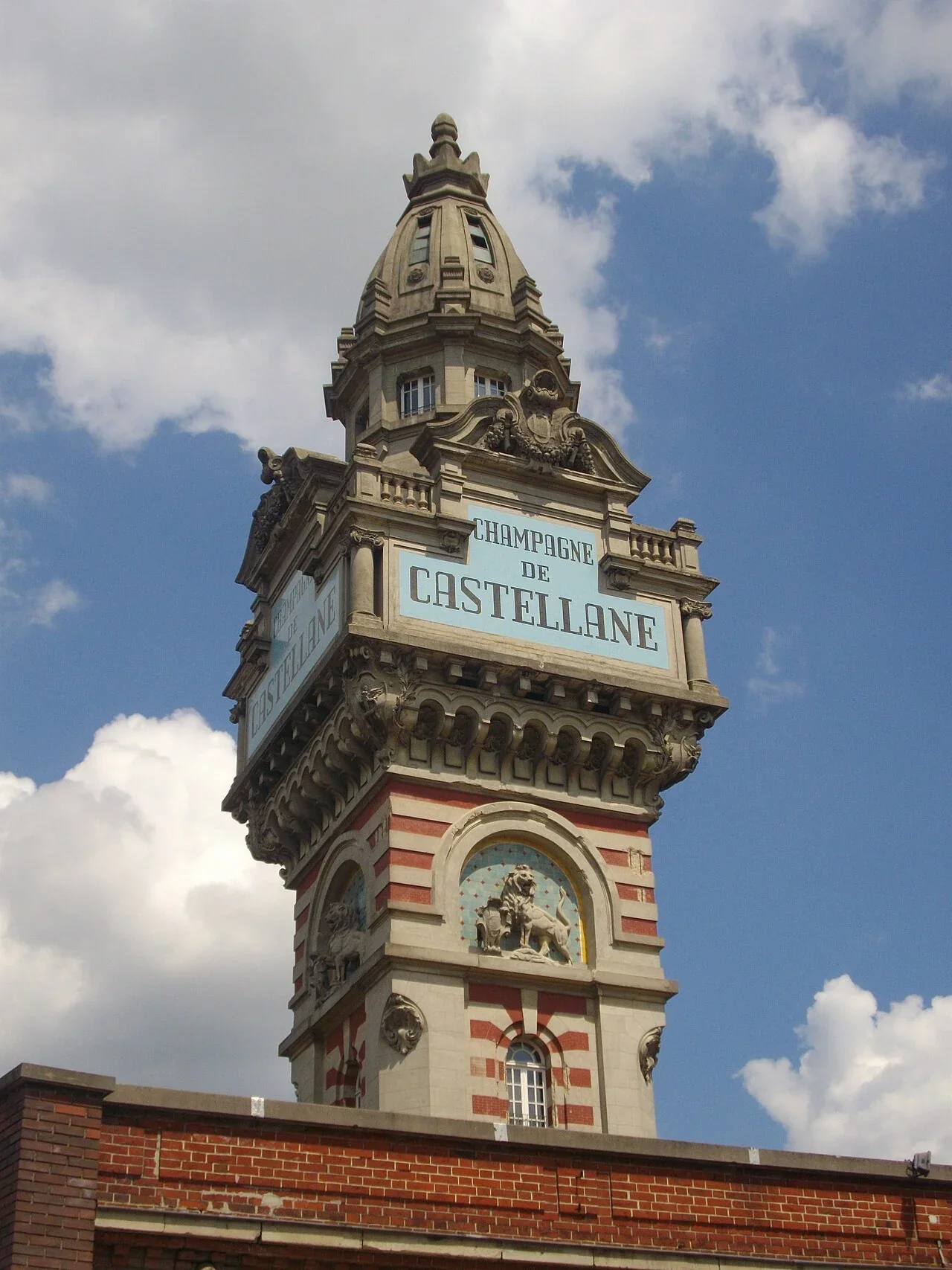
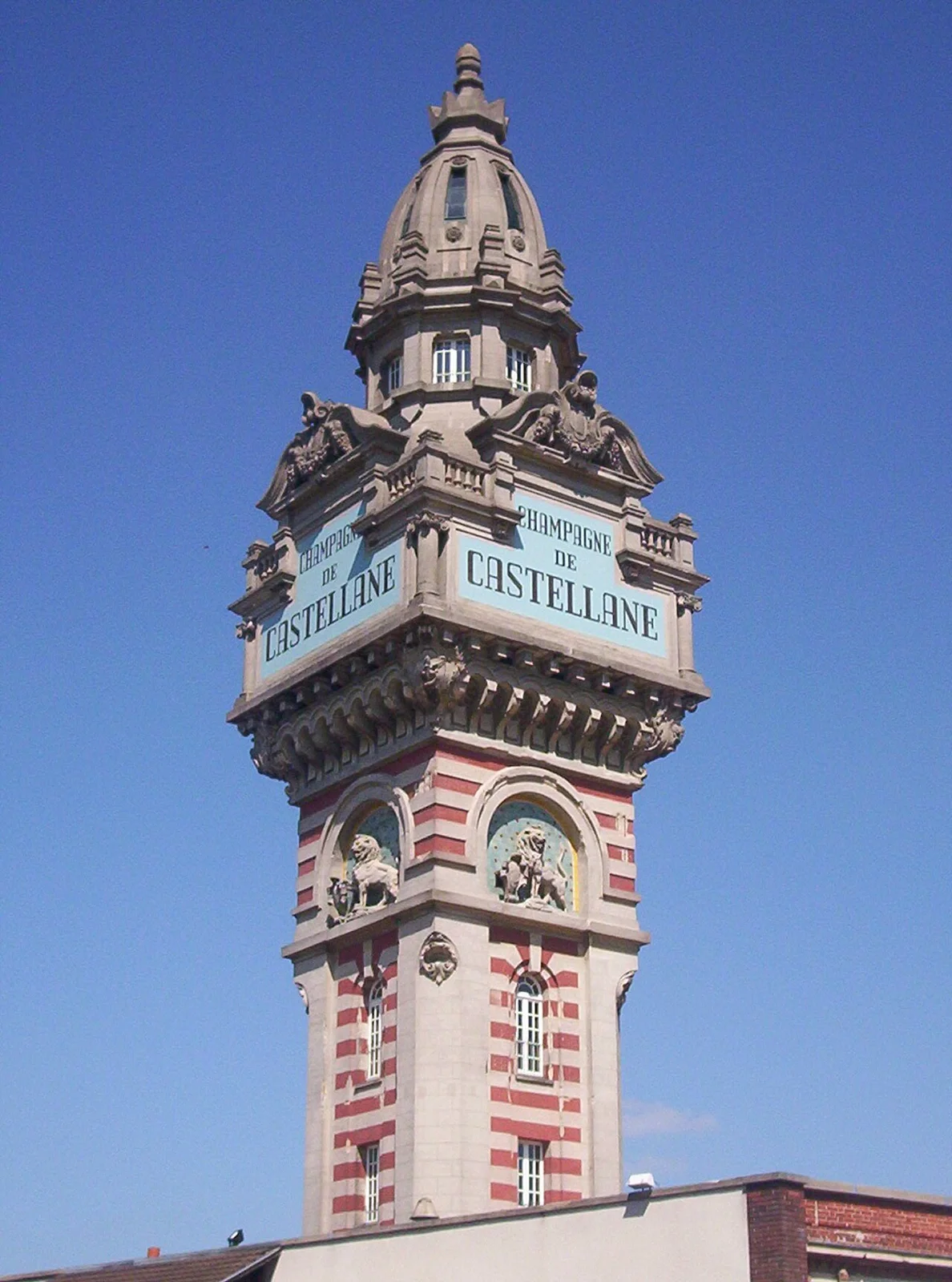
Union Champenoise, under Fernand Mérand, acquired de Castellane in 1907. Its Épernay complex brought production and sales together beside the Paris–Strasbourg railway. Architect Marius Toudoire is credited with the buildings. Brickwork, stone balustrades, sculpture and enamel decoration combined factory functions with an imposing public façade; destination names such as London, Brussels and Alexandria advertised the export trade.
The Champagne World Heritage account dates new warehouses and the tower to 1903–04. It describes the tower as both a water-storage structure and an advertisement to passing train passengers. The structure entered the supplementary historic-monument register in 1990. Today the producer describes a 66-metre tower above eight floors, while its buildings extend roughly 200 metres beside the railway.
Alexandre Mérand developed international sales after succeeding his father’s generation. After Alexandre’s death in 1970, his daughter Claude directed the company. Her husband was Bernard de Nonancourt of Laurent-Perrier. De Castellane formally entered the Laurent-Perrier group in 1999. The surviving complex combines residences, production premises, chalk cellars and heritage collections.
Alexandre Mérand expanded exports to cities including London, Brussels, Berlin, Stockholm, New York, Alexandria and Sydney.
de Castellane: the place and its story
The standard tower ticket includes the museum, permanent exhibition, panoramic view and Brut Croix Rouge. The two-wine tower ticket adds Brut Rosé or Cuvée Commodore. The Heritage Tour includes the label room, whose 7,000 drawers preserve a collection of 10,000 labels and neck collars.
Tower groups are limited to ten; the Heritage Tour to six. The Heritage Tour is reservation-only, with listed departures at 10:00, 14:00 and 16:00. Book through visites@castellane.com or +33 (0)3 26 51 19 11. Dogs are not admitted on the tours.
The Union des Maisons de Champagne attributes the buildings to Marius Toudoire. Red brick, dressed-stone balustrades, sculpture and enamel decoration distinguish the complex. Names of shipping destinations, including London, Brussels and Alexandria, remain on the façades. A direct rail connection historically linked the cellars to the mainline railway.
The house Brut blends 35% Chardonnay, 35% Pinot Noir and 30% Meunier, with approximately 15% reserve wines. It matures for at least twenty-four months in cellars held at 10°C. The dosage is 9g/l, followed by at least another three months of rest before shipment. This is the Brut Croix Rouge served on the standard tower programme.

Visits and tastings
| Experience | Duration | Adult price from | Tasting | Languages | Booking |
|---|---|---|---|---|---|
| Guided Tour of the Tower | 60 minutes | €20 (checked October 2026) | Brut Croix Rouge | Ask the house | Official booking |
| Tower tour with two Champagnes | 75 minutes | €30 (checked October 2026) | Brut Croix Rouge plus Brut Rosé or Cuvée Commodore | Ask the house | Official booking |
| Heritage Tour | 90 minutes | €60 (checked October 2026) | Two cuvées | Ask the house | Official booking |
A factory designed to face the railway
The official architectural account describes a 200-metre frontage beside the Paris–Strasbourg railway. Vat rooms, bottling equipment and six kilometres of chalk cellars were gathered within one complex built against the Épernay hillside. The arrangement reduced transfers of wine and exposure to daylight and temperature changes. The cellar network remains part of the working property even while the public cellar route is closed.
The Champagne World Heritage association describes the site’s combination of the owner’s residence, employee housing, production buildings, warehouses and sales spaces. It records a 43,500-square-metre complex and explains that the tower served both as a water tower and as an advertisement to passing rail passengers. Its historic-monument registration dates to 1990. These industrial functions distinguish de Castellane from an Avenue mansion used chiefly for hospitality.
Separate grapes, separate vats
De Castellane’s production account specifies hand harvesting and separate vinification of Chardonnay, Pinot Noir and Meunier from individual villages or crus. Fermentation takes place at low temperature in adapted vats before the cellar master selects the components for blending. That separation precedes the familiar red-cross Brut, which combines all three grapes.
The house’s blending account associates Chardonnay with citrus and white flowers when young, then butter and honey with age; Pinot Noir supplies structure and red-fruit notes, while Meunier gives earlier fruit and roundness. Its maturation account describes regular tastings and laboratory checks during the years spent in the chalk cellars. The dosage liqueur is the final adjustment to a wine already assembled and matured.
Brut Rosé: the second-glass option
Brut Rosé is one of the two choices offered as the second glass on the €30 tower programme. Its technical page gives 40% Pinot Noir, 30% Meunier and 30% Chardonnay, with approximately 15–17% red wine depending on the year. The red wine is selected from Pinot Noir villages; the rosé is an assemblage rather than a white wine whose colour comes solely from its grape names.
The published production sequence is about five months in vats, followed by 24–30 months of bottle maturation before disgorgement and a further three months of rest after dosage. De Castellane recommends serving Brut Rosé at about 10°C. Its suggested pairings include salmon, strawberry tart, fruit salad and sorbet. Cuvée Commodore is the alternative second glass on the tower ticket; the booking page does not describe that choice as an additional third pour.
Demi-Sec and the difference in dosage
De Castellane’s Demi-Sec uses 40% Pinot Noir, 30% Chardonnay and 30% Meunier, with 38 g/L dosage. This is considerably higher than the 9 g/L published for Brut Croix Rouge. The house specifies a dosage liqueur made from Chardonnay and Pinot Noir, five months in vats and twenty-four months of cellar maturation.
The producer pairs Demi-Sec with sweet-and-sour dishes and desserts including fruit tart, ice cream and crêpe Suzette. It is a separate wine in the published range: neither the one-glass tower programme nor its two-glass version lists Demi-Sec as an included pour. The currently listed second-glass choice is Rosé or Commodore.
Posters, printing and the red cross
The house’s art collection grew around the Saint Andrew’s cross chosen in 1895. De Castellane commissioned painting and advertising posters that took the symbol into public streets; Cappiello’s 1902 work belongs to that history of early illustrated promotion. The Heritage Tour concentrates on these collections and regional traditions, including printed labels, rather than offering the currently closed underground circuit.
The Champagne World Heritage account identifies a printing museum and a museum of local traditions within the complex. Labels were both sales material and records of changing presentation: the house’s collection runs from the nineteenth century to the present. The dedicated Heritage Tour’s six-person limit is smaller than the ten-person tower groups. Its scheduled start times are separate appointments, not a ticket to move independently around the production buildings.
The Nonancourt family connection
After Alexandre Mérand’s death in 1970, his daughter Claude directed the business. She was married to Bernard de Nonancourt, owner and director of Laurent-Perrier. The 1999 group entry thus followed a family connection already recorded in de Castellane’s chronology.
Access and facilities
De Castellane currently states that its cellars are temporarily closed to the public. Its official programme instead offers the tower and Heritage Tour from 57 rue de Verdun, Épernay. The tower is 66m high, with eight floors and 237 steps.
The tower route’s 237 steps across eight floors are a physical feature of this booking. The published programme does not offer a lift alternative to its 360-degree viewing point. Anyone unable to climb that route should ask the house about museum or tasting arrangements before purchasing a tower ticket. Dogs are expressly excluded from the tours; the house also applies the legal drinking age to the tasting.
Use 57 rue de Verdun for the visitor entrance and quote the exact programme when writing to visites@castellane.com: the one-glass tower visit is 60 minutes, the two-glass tower visit 75 minutes, and Heritage 90 minutes. The official page publishes reception hours of 10:00–12:00 and 14:00–18:00 daily. A confirmed language and start time should accompany the reservation.
Official information
Plan nearby visits
Build your visit into a fuller stay with our Épernay guide, compare tours and packages and find somewhere comfortable to stay.
Plan your trip to Épernay
Get there
Book a tour
Select the departure point and date on the booking page. Check the meeting point, language and inclusions before paying.
Compare toursWe may earn a commission if you book through these links, at no extra cost to you.