

The oldest house: Ruinart, founded in 1729
Ruinart’s founding charter was signed by Nicolas Ruinart in Reims on 1 September 1729. The house identifies itself as the first Champagne-producing company; the region’s World Heritage mission also calls Ruinart the oldest Champagne house. Its present visitor address, 4 rue des Crayères, brings that eighteenth-century business into the chalk landscape of Saint-Nicaise Hill. The oldest house is a documented starting point for this list, not a claim that wine production began in Champagne in 1729.
Nicolas drew inspiration from his uncle Dom Thierry Ruinart, a Benedictine scholar who lived from 1657 to 1709 and encountered sparkling wine while at Saint-Germain-des-Prés near Paris. The family’s later acquisition of chalk quarries gave the company room to store its bottles. Ruinart’s relationship with art has another dated landmark: Alphonse Mucha produced an advertising poster for the house in 1896. Its current commissions continue that connection between bottles, architecture and artists.
Cellar distances: networks, not the length of your tour
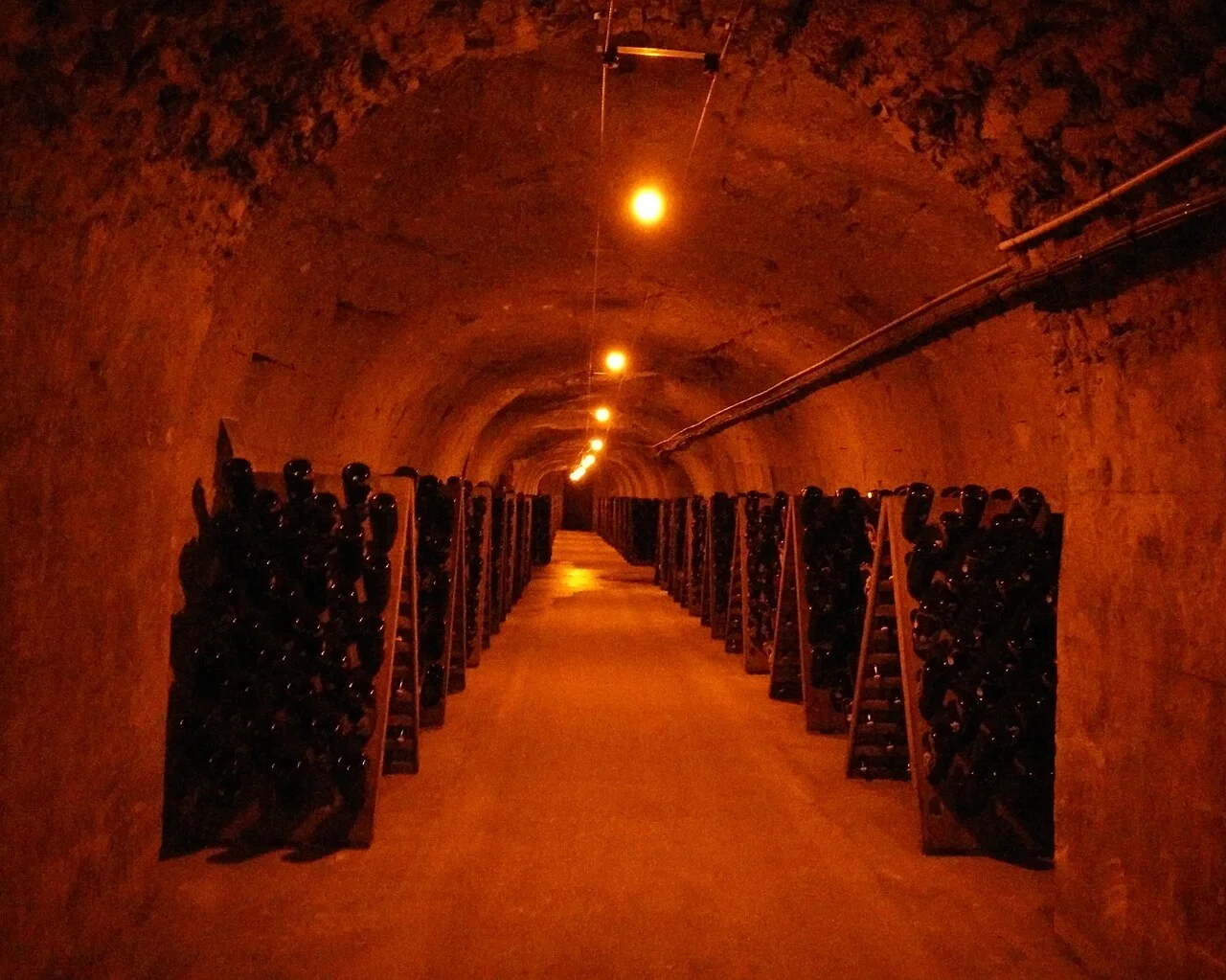
Moët & Chandon describes twenty-eight kilometres of underground cellars beneath Épernay. Mumm gives almost twenty-five kilometres beneath Reims, Ruinart eight kilometres, and Mercier eighteen kilometres beneath the Avenue de Champagne. These are published network figures, not distances walked on the visitor tickets. Moët’s Imperial Moment lasts ninety minutes; Mercier carries visitors through part of its network by train. A cellar network and a guided visitor route are different measurements.
Moët’s official visit page calls its cellars the biggest Champagne cellar. That is the house’s description; the figures on this page do not establish an independently audited ranking of every regional cellar or connected municipal tunnel. For a trip, the useful comparison is the experience: Moët’s galleries and white/rosé tasting, Mercier’s train and carved reliefs, or Ruinart’s tall chalk chambers. Our house directory links the individual routes and their booking pages.

Depth: eighteen metres, thirty metres and uncertain comparisons
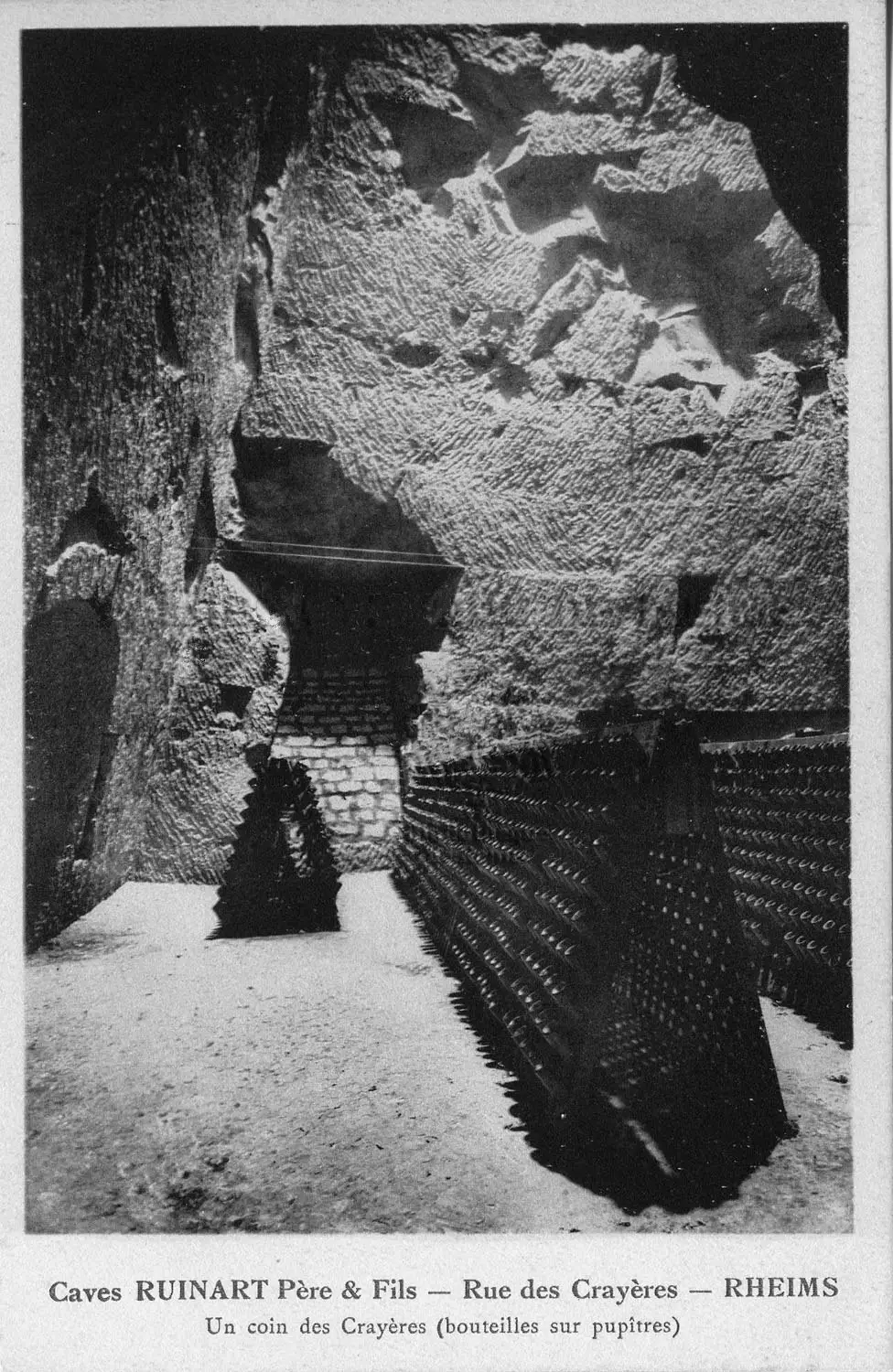
Taittinger places its visitor route eighteen metres below Saint-Nicaise Hill, among Gallo-Roman quarry spaces and remains of the medieval Saint-Nicaise abbey. Mercier describes its single-level Épernay cellars as approximately thirty metres underground. Pommery also quotes approximately thirty metres, with a descent of 116 steps. These named visitor routes give a sense of the landscape beneath the streets without turning a staircase count into a universal depth record.
Ruinart’s own pages use differing depth figures, so a claim that it is definitively Champagne’s deepest cellar is not made here. The World Heritage mission distinguishes the height of a chalk chamber from its depth below the ground: it describes a surviving Ruinart chamber thirty-eight metres high. A chamber height, a shaft depth and the level reached by a visitor are three different measurements. The Ruinart visit guide sets out the booked route and its access arrangements.
1810, 1816 and 1818: Madame Clicquot’s sequence
Veuve Clicquot’s official history credits Barbe-Nicole Clicquot Ponsardin with the house’s first vintage Champagne in 1810, the riddling table in 1816, and blended rosé Champagne in 1818. She had taken over the business in 1805, aged twenty-seven, after the death of François Clicquot. The dates mark distinct developments: identifying a single harvest, clarifying the wine, and producing a rosé by blending in red wine.
The riddling table allowed bottles to be gradually tilted and turned so sediment gathered in the neck for removal. The house’s 1818 rosé account names red wine from Bouzy as the blending component. Ruinart, meanwhile, records shipping rosé in 1764. These statements concern different milestones: an earlier rosé shipment and a later blended-rosé technique. They should not be collapsed into a single claim that no rosé existed before 1818.
The widows who changed the houses
Madame Pommery took charge of the Reims business after her husband died in 1858. In 1868 she bought a fifty-hectare estate on Saint-Nicaise Hill, and the cellars officially opened in 1878. Pommery dates its breakthrough dry style to 1874, aimed at British tastes. The red-brick and blue-grey estate evokes English architecture, making its export story visible above ground as well as in the named 1874 cuvée.
At Laurent-Perrier, Mathilde-Emilie Perrier succeeded Eugène Laurent after his death in 1887 and joined their surnames in the house name. She launched Grand Vin Sans Sucre in 1889. Another widow, Marie-Louise de Nonancourt, bought Laurent-Perrier in 1939; her son Bernard became chief executive in 1948 after working through the vineyards and production. These are two separate changes of ownership and leadership within one Tours-sur-Marne house.
The word veuve means widow, which explains its appearance in Veuve Clicquot and the historical name Veuve Laurent-Perrier. Pommery’s and Laurent-Perrier’s dry-wine milestones also show why the widows’ story is more than a label anecdote: it connects management, international customers and the taste of the wine. Visit the Pommery estate or read Laurent-Perrier’s history with those individual women and dates in view.
Cuvée landmarks and the meaning of a date
Pol Roger created Cuvée Sir Winston Churchill as a tribute to its association with the British statesman. Its first vintage was 1975. A vintage label makes an important distinction: the number on a vintage label describes the grapes’ year, while the wine may reach customers much later after cellar ageing. Pol Roger’s working premises at 34 avenue de Champagne are not open for public visits.
Lanson created Black Label in 1937 and introduced Le Black Création in 2023, followed by Le Rosé Création in 2024. Its archive also identifies a rosé in 1833. These are house-specific milestones, with a modern name change sitting alongside nineteenth-century winemaking history. At a tasting, read the current cuvée name on the reservation: an archive date does not guarantee that an old release will be poured on today’s cellar ticket.
UNESCO: 1991 and 2015 recognise different histories
Champagne Hillsides, Houses and Cellars entered the World Heritage List on 4 July 2015, at the committee’s thirty-ninth session in Bonn. Its three ensembles link the historic hillsides around Hautvillers, Aÿ and Mareuil-sur-Aÿ; Saint-Nicaise Hill in Reims; and Épernay’s Avenue de Champagne with Fort Chabrol. UNESCO recognises the combined wine-growing, production and trading landscape, not a ranking of the most expensive bottles.
Reims Cathedral, the former Abbey of Saint-Rémi and the Palace of Tau belong to a separate World Heritage property inscribed in 1991. The two inscriptions can overlap in a visitor’s day but remain different listings, numbered 601 and 1465. Read the UNESCO guide before planning a cathedral visit and a Saint-Nicaise tasting: architectural heritage and the Champagne production landscape each have their own history and opening arrangements.
Collective firsts: protecting the name and rebuilding the vines
The Champagne appellation was formally recognised on 29 June 1936, and the Comité Champagne was created in 1941. Collective defence of the name had begun earlier: the Comité’s current appellation factsheet dates the first such steps to 1843. These milestones distinguish a regional product protected by origin and production rules from a house brand or a single founder’s invention.
Fort Chabrol, at 1 route de Mardeuil in Épernay, became a practical viticulture school in 1900. Moët & Chandon’s research and training centre helped growers respond to phylloxera through grafting local vine varieties onto resistant American rootstocks. It received historic-monument status in 2012 and forms part of the 2015 UNESCO property. Its importance is collective research and teaching; public access follows the specific current authorised visit, not the heritage designation alone.
Mercier’s nineteenth-century showmanship
Mercier introduced electricity into its cellars in 1886, took its giant blending vat to the Paris World’s Fair in 1889, and welcomed President Sadi Carnot underground in 1891. The house gives the vat’s capacity as the equivalent of 200,000 bottles. The giant vat turned a working blending vessel into a landmark of the 1889 exhibition. Gustave Navlet’s underground relief commemorates Carnot’s visit.
Plan your trip to Champagne
Get there
Book a tour
Select the departure point and date on the booking page. Check the meeting point, language and inclusions before paying.
Compare tours ↗We may earn a commission if you book through these links, at no extra cost to you.