
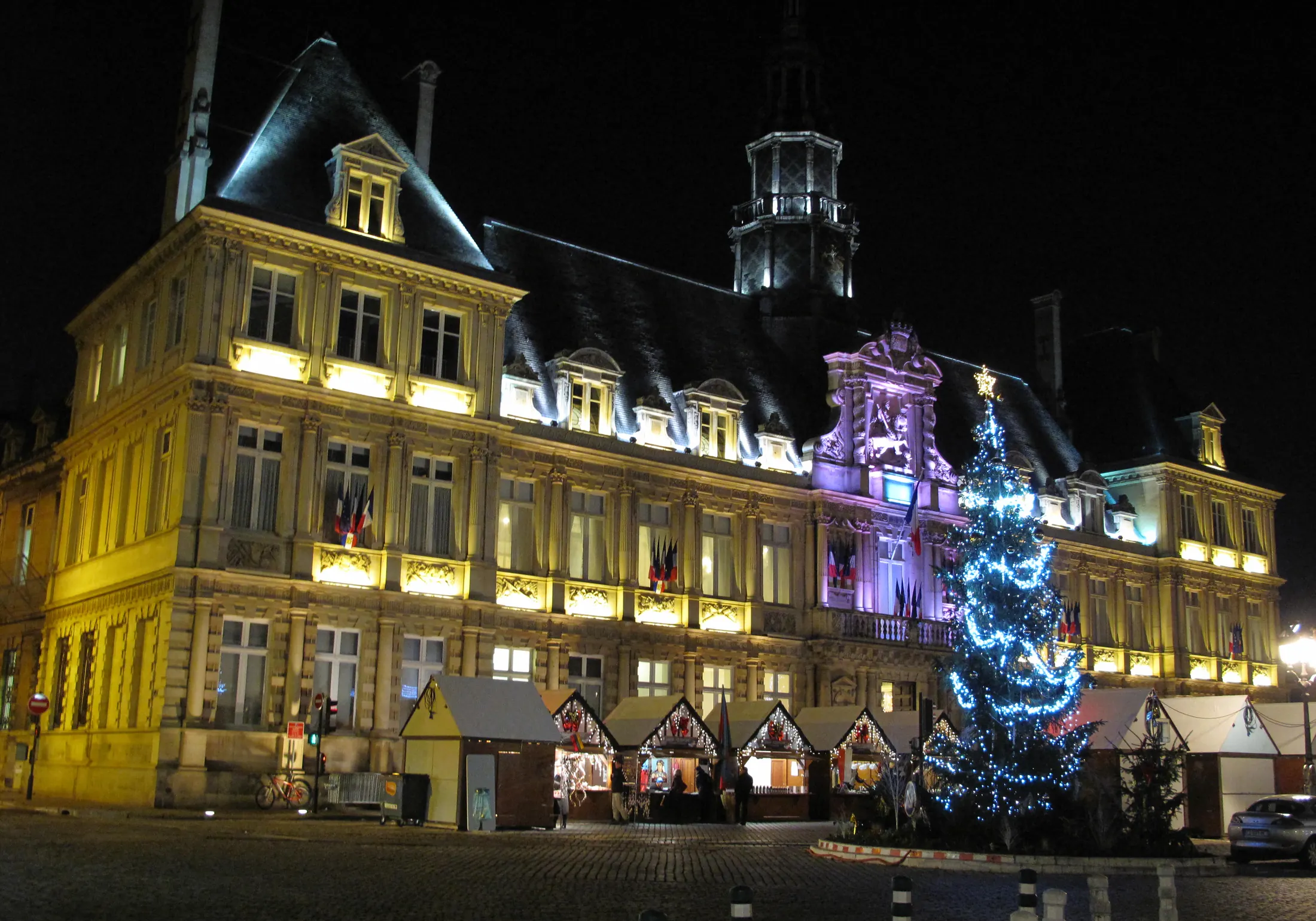
1996: twenty chalets on place d’Erlon
Reims’s Christmas market began in 1996 with about twenty chalets on place Drouet-d’Erlon. Les Vitrines de Reims organised that first edition with support from the city. Its original setting was the long central square still known for cafés, restaurants and shops, putting Christmas shopping among the ordinary businesses of Reims. The city’s later history of the event makes this modest beginning a useful starting point: today’s much larger seasonal village grew from a local commercial initiative.
The market subsequently changed address twice. In 2016 it moved to the cathedral forecourt, where it remained through 2021. In 2022 it relocated to the Hautes Promenades Jean-Louis Schneiter. These moves explain why photographs of Reims at Christmas can show very different backdrops. An older picture of chalets beneath Notre-Dame records a real former layout, while the present market belongs to the landscaped area near Reims Centre station and the Porte de Mars.
The city records 725,000 visitors for the 2022 market, the first year on the Promenades, and more than one million in 2024. Its retrospective describes roughly 150 chalets in the established modern format. Those attendance figures are the organiser’s records for named years, not a guarantee of another season’s crowd. The increase from twenty chalets in 1996 to the later village shows how far the event’s scale changed over three decades.
The cathedral years: a different Christmas postcard
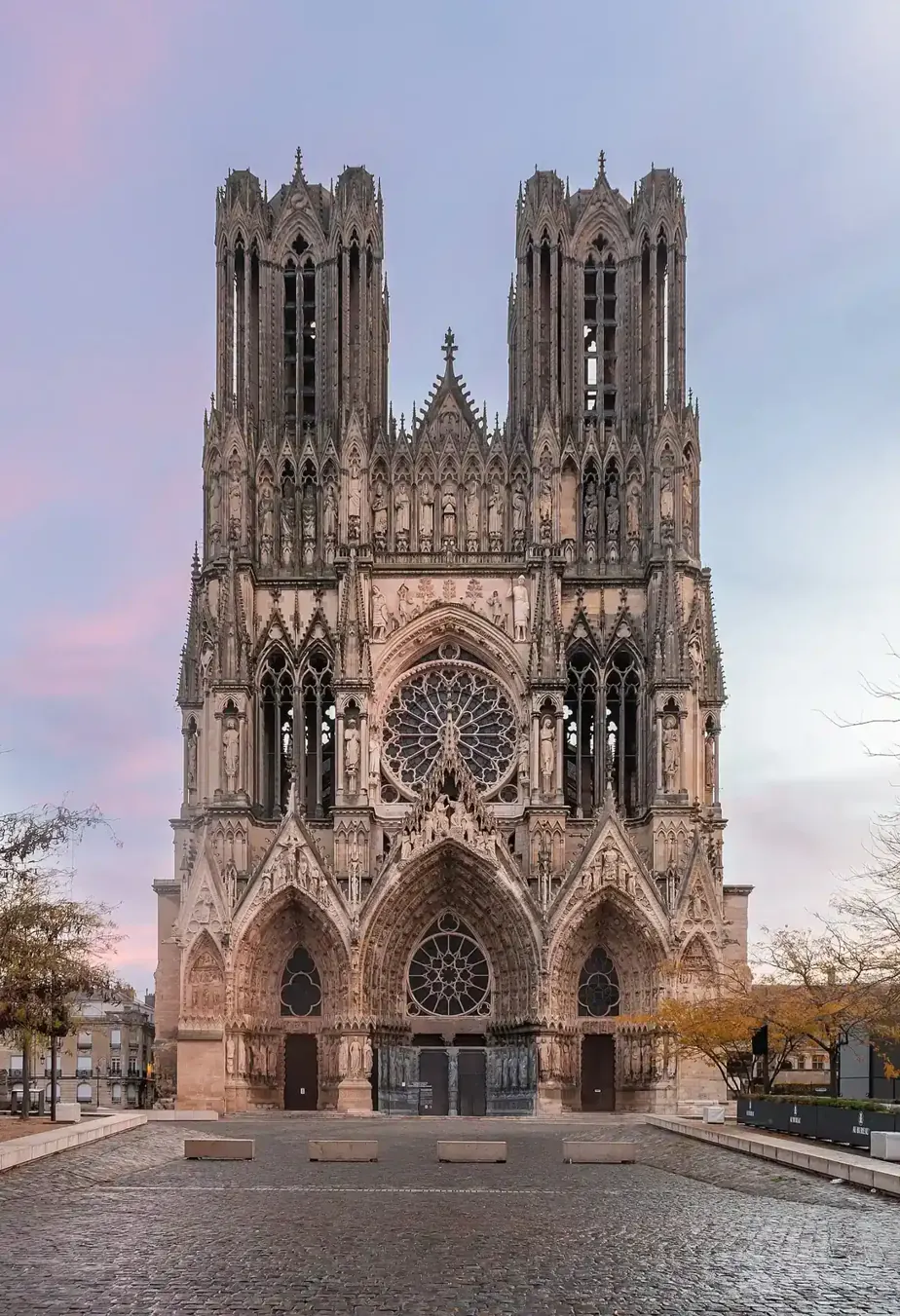
The cathedral setting gave the market a conspicuous historical frame from 2016. Reims tourism’s 2017–2018 visitor booklet presented the Christmas village on Notre-Dame’s forecourt, while contemporary photographs show rows of wooden chalets against the Gothic façade. These are records of the market’s cathedral phase. They are useful for understanding its visual identity, but a modern visitor following an old photograph to that exact spot would miss the main market on the Promenades.
Notre-Dame, the Palace of Tau and the former Abbey of Saint-Rémi had entered the UNESCO World Heritage List in 1991, five years before the Christmas market began. The cathedral’s thirteenth-century sculpture and architecture therefore supplied a protected heritage setting for a much younger event. The distinction is worth keeping: the market is a modern seasonal celebration, while its former backdrop belongs to Reims’s long royal and religious history.
The cathedral light programme also changed during that period. Regalia, created for the city by Moment Factory in 2019, succeeded the earlier Rêve de Couleurs illumination in Reims tourism’s annual activity report. Regalia tells the story of a royal coronation day through projection and music. It was a separate public production alongside the market, adding an evening spectacle to the cathedral quarter without becoming a stall or a ticket included with Christmas purchases.
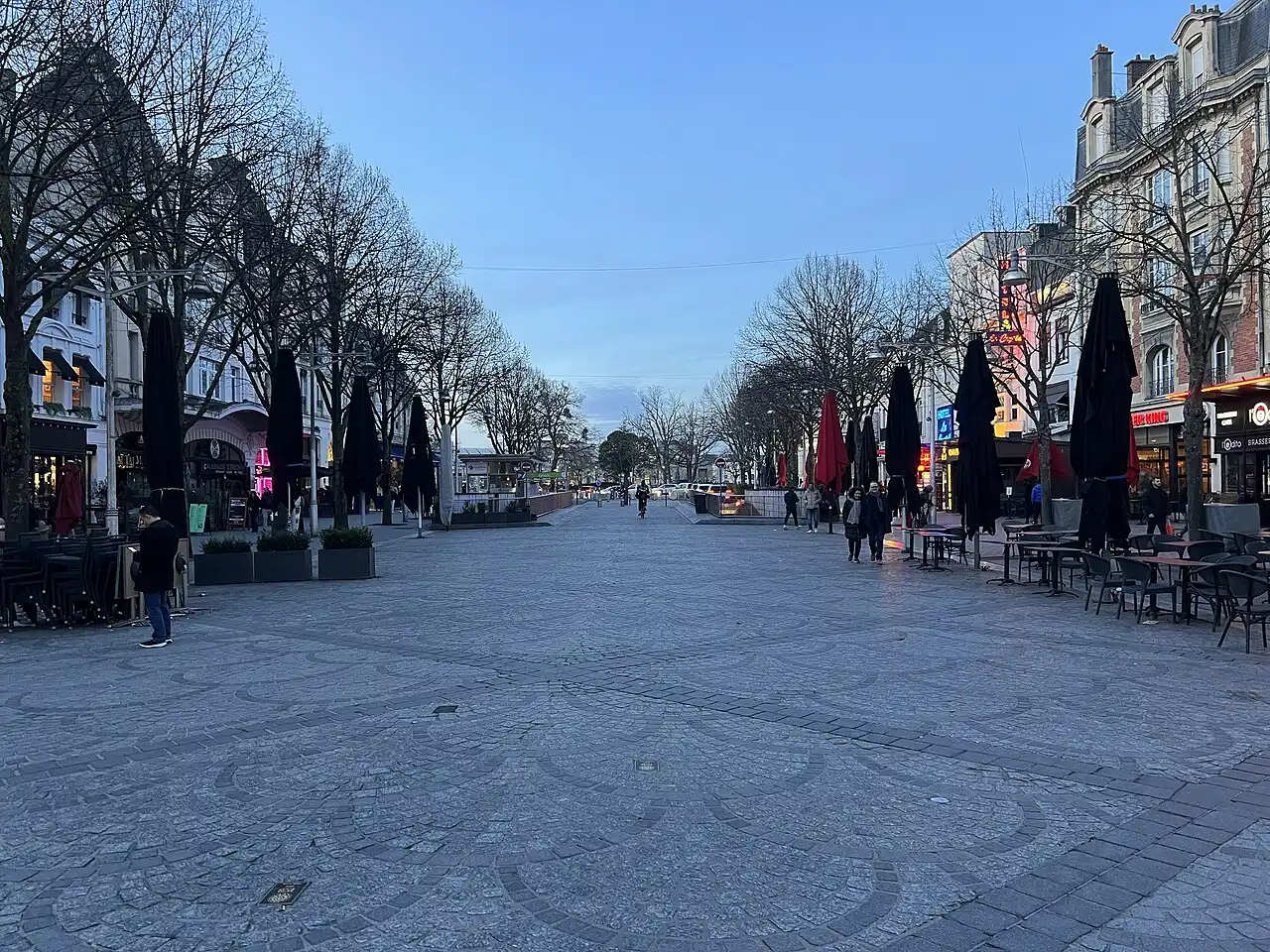

2022: moving to a renewed landscape
The Hautes Promenades had themselves been comprehensively redesigned in 2019 as part of Reims Grand Centre. The city and tourist office describe renewed planting and recreation equipment along the broad public route. The market’s 2022 move therefore placed the chalets in a recently transformed city-centre landscape. This was a change of urban setting as well as a practical shift in the address used by stallholders and visitors.
The Promenades’ address is allée des 7 et 8 Mai 1945. Their position near Reims Centre and the Porte de Mars gives the Christmas market a different relationship with the city from its cathedral phase. The former backdrop was a medieval church façade; the newer location combines a planted promenade, a mainline railway arrival and a Roman monument at the northern end of the centre. Those landmarks make the market’s modern geography easy to recognise.
The Porte de Mars is approximately 32 metres long and twelve metres high, according to Reims tourism. It is one of the substantial surviving monuments of Roman Reims. The Christmas programme uses the neighbouring esplanade as well as the Promenades, placing temporary winter attractions beside a much older city gateway. The Roman arch did not inspire the market’s 1996 foundation; it became part of its setting when the event moved northwards.
A Christmas season spread across Reims
The 2025 municipal magazine placed the market within a wider Christmas walk through the city. Its programme connected the market, the cathedral and Saint-Maurice church, with light projections at several sites. This meant the Promenades move did not remove the cathedral quarter from the festive season. Instead, the main chalet village and other winter attractions occupied distinct addresses, encouraging visitors to follow the city’s streets between them.
The municipality of Prunay’s dated November 2025 notice preserved three projection locations from that season: the Palace of Tau façade seen from square Henri Deneux, Saint-Maurice church on place Museux and the Fontaine des Boucheries on place Jules Lobet. It listed the mappings from 17:00 until midnight. Those are details of the completed 2025 Christmas programme, not opening hours or locations automatically carried forward to every subsequent December.
The City of Reims also published an online Advent calendar for 1–24 December 2025. This digital activity sat beside the physical market and street illuminations. It is a small example of how the modern Christmas programme extends beyond its original cluster of wooden sales chalets: the city now presents a collection of seasonal activities, with each one retaining its own date, location and form of participation.

2025 and 2026: reading the edition on the programme
The 2025 market ran from 26 November to 28 December in the city’s winter programme. The announced 2026 edition runs from 25 November to 27 December, on the Hautes Promenades and the Porte de Mars esplanade. A one-day difference in the opening and closing dates is enough to make a previous year’s leaflet unreliable for a booked trip. Historical programmes are good evidence of how the event developed; the current city announcement supplies the calendar for the coming visit.
Marne tourism’s 2026 description lists 150 chalets offering crafts, decorations, food and festive products. It also names a Christmas tree and a 50-metre Ferris wheel on place Drouet-d’Erlon. That brings the original market square back into the story as a separate attraction location. The modern Christmas visit therefore has more than one centre: the principal chalet village lies on the Promenades, with other festive landmarks distributed through Reims.
The market’s modern history is also a story of local organisation. Les Vitrines de Reims appears in the city’s account of the first twenty chalets in 1996 and remains associated with the later celebration. The municipality, traders and the visitor-information network describe different parts of the same city-wide season. Its success is visible in named moves, chalet numbers and dated attendance reports, without needing an unsupported claim that Reims outranks every other French Christmas market.
Following the market’s three addresses
To see the history on the ground, start with place Drouet-d’Erlon, where the twenty-chalet market began in 1996; look at the cathedral forecourt used from 2016 to 2021; then walk towards the Promenades and Porte de Mars, the market’s setting since 2022. These three places tell the story more clearly than one supposedly timeless Christmas postcard. Each relocation added a different part of central Reims to the event’s visual memory.
The Reims Christmas Market visitor guide links the current programme and travel information. For a wider winter trip, the Christmas itinerary separates the Reims market from Épernay’s Habits de Lumière, founded in 2000. They are different celebrations in different towns, with their own histories and calendars. Reims’s particular story begins with its traders on place d’Erlon and continues among the trees of the Promenades.
Plan your trip to Reims
Get there
Book a tour
Select the departure point and date on the booking page. Check the meeting point, language and inclusions before paying.
Compare toursWe may earn a commission if you book through these links, at no extra cost to you.